Need Different Solutions?
For any problem with development or anything related to service connect with us

Deploy custom AI agents for IT that automate service desk requests, accelerate system troubleshooting, monitor infrastructure, and orchestrate internal workflows across your enterprise stack.
IT teams spend a good part of their day dealing with requests that need attention but not necessarily deep technical expertise. Password resets, access requests, ticket sorting, software permissions, and recurring alerts can take time away from larger infrastructure and engineering work.
An AI agent for IT can take care of some of this routine work. It can read a support request, check relevant information, follow an approved process, and involve an IT specialist when the issue needs human judgment.
At Amenity Technologies, we develop IT agents around the systems, access rules, and working methods already used by your team.
An IT setup that works well for a smaller organization can become harder to manage as the company grows. More users arrive, new applications are added, remote access becomes more common, and cloud services bring another layer of administration.
The workload does not always grow in obvious ways. A team might spend very little time on access requests one week and then deal with a large number of them after a new system is introduced.
A custom AI agent for IT can handle defined parts of this workload, from sorting incoming requests to checking information before a routine action is taken. Your engineers can then spend more time on issues that actually need their attention.
Not every IT issue needs a senior engineer. A locked account, a routine software request, or a question covered by an existing support procedure can often be handled without escalating the ticket.
The difficulty is volume. When hundreds of small requests arrive, even simple tasks create a queue.
An IT agent can work through those requests according to rules set by the organization. It can resolve suitable cases, gather information for the next person, or stop and ask for human help when the situation falls outside those rules.
The useful starting point is usually a task that already follows a reasonably clear process. From there, the automation can be built around the tools and controls your IT team already uses.
Password questions, software issues, and access requests can make up a sizable part of a helpdesk queue. An AI assistant can deal with the routine ones, leaving the team to focus on harder problems.
A request may arrive without enough information to act on it. The agent can ask a few basic questions first, then send the completed request to the right person or team.
For many employees, opening a ticket feels unnecessary when the question is simple. An internal assistant can provide quick answers to common IT questions without adding another request to the queue.
Some IT work is repetitive by nature. The same checks, updates, and handoffs happen again and again. Those parts can be automated, while anything outside the usual process stays with the team.
Employees shouldn’t have to search through several systems for a simple piece of information. A connected AI chatbot can pull together the information it has permission to access and present it in one place.
Off-the-shelf tools won’t always match the way an IT department works. A custom assistant can be shaped around the team’s existing systems, processes, and rules, rather than asking the team to change them.
Giving software permission to change an enterprise system requires care. Restarting a service or changing a user’s access is very different from answering a basic support question.
That distinction should be built into the agent from the beginning. Routine actions can be automated within clearly defined limits, while sensitive changes can require approval from an administrator. Activity should also remain visible so the IT team can see what happened and why.
This approach allows automation to take care of the predictable work without handing over unrestricted control of the environment.
An alert is only useful if someone can do something with it.
For example, a monitoring system may report that storage is running low, while a helpdesk platform may receive repeated reports about the same application. Without a process behind those alerts, they can simply add to an already busy queue.
An AI agent for IT can connect the information coming from these systems with approved response steps. It may gather additional details, perform a routine check, or send the issue to the right person with the relevant context already attached.
Most organizations already depend on ITSM platforms, identity providers, cloud services, monitoring tools, and internal applications. Replacing those systems just to introduce an AI agent usually creates more work than it solves.
The agent can instead sit within the existing environment and work with the tools already in place. Tickets can continue to live in the current service desk, user records can remain in the existing directory, and monitoring can continue through the platforms the IT team knows.
This is particularly useful for organizations with older systems that still perform important jobs but were never designed with AI automation in mind.
Ticket volume alone does not tell an IT manager whether support is working well. A queue may look healthy while resolution times increase or the same problem keeps returning.
Tracking those patterns can reveal where the process needs attention. An automated system can compare current support activity with the team’s usual numbers and flag unusual changes for review.
That might mean a sudden increase in access requests, more tickets around one application, or a drop in first-contact resolution. The point is not to make every decision automatically. It is to make useful information easier to spot.
The value of an IT agent is not measured by how many tasks can be automated. It comes from choosing the right ones.
Password resets, routine access requests, ticket sorting, and repetitive checks are good places to start when they follow clear rules. More sensitive infrastructure changes may still belong with experienced administrators.
Amenity Technologies can help identify those opportunities and develop an AI agent for IT around your existing systems and processes. If routine IT work is taking time away from projects that need your technical team, a focused discussion can help determine where automation actually makes sense.
As an emerging Gen AI development company, our expertise spans a diverse range of models that help you in achieving new levels of creativity, efficiency, and intelligence.
ChatGPT
Claude
Gemini
Llama
DeepSeek
Qwen
FLUX
Stable Diffusion XL (SDXL)
Whisper
ElevenLabs
Addressing Unique Problems with Advanced Gen AI Solutions.
500+
AI Projects Delivered Across Industries
100+
Generative AI Models Mastered
200+
Global Clients Empowered
5x
Faster Deployment Expertise
99.9%
Client Satisfaction Rate
30
Served with Scalable AI Services
Trusted by 2,000+ Brands
Read our case studies, which showcase our experience and strategy for implementing different Gen AI models into business workflows successfully.
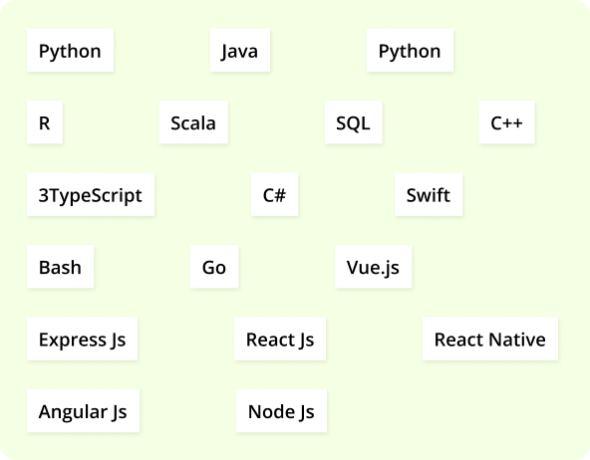
At Amenity Tech, we have a pre-vetted pool of talented developers with expertise and hands-on
experience in a range of technologies.
Create dynamic web apps using reusable components with React.
Develop structured, scalable front-end apps with Angular.
Lightweight, fast, and flexible interfaces built with Vue.js.
Create interactive, responsive websites using core JavaScript skills.
Design clean, responsive layouts using HTML5 and CSS3.
Build fast and flexible apps or data tools with Python
Develop modern web apps using Laravel’s PHP framework.
Create real-time, high-performance apps with Node.js.
Secure, scalable back-ends built with Django and Python.
Build sleek iOS apps with Swift and Apple-native tools.
Create reliable Android apps for all devices and versions.
Cross-platform apps from a single codebase with Flutter.
Build native-like mobile apps with shared React code.
Integrate smart, AI-powered features into your app.
Deploy AI chat solutions using OpenAI’s ChatGPT.
Design and train deep learning models with PyTorch.
Optimize AI outputs with expert-crafted prompts.
Extract insights from complex data with AI and ML.
Visualize and interpret data to guide business decisions.
Build scalable pipelines and manage data infrastructure.
Testimonials
Read what our clients have to say about the Amenity Tech partnership and the benefits they have received from our innovative Gen AI solutions.
The Amenity Team is a standout group of professionals in AI chatbot development, consistently delivering bug-free, expert-level code. Their strong communication skills and seamless collaboration make working with them a breeze. With deep expertise in AI chatbot projects using LLMs and ChatGPT, including web and WhatsApp platforms, you’re in the best hands!
Ganesh Tangella
Have the honor and privilege of working with Amenity on many projects these last 6 months. Amenity has demonstrated immense and exceptional capabilities in developing robust custom computer-vision-learning algorithms, Deep Neural Networks, and Convolutional Neural Networks, and has advanced our R&D exponentially! Trust can never be more valuable and critical for any startup, especially when building and developing partnerships!
I must thank Amenity for opening our eyes and expanding our AI capabilities beyond measure!
Charles B. Moss II
Excellent work, Great communication throughout the project. Took time to understand the task then provided an excellent out come.
Hanif-jan-mohamed
Dealing with amenity such good experience on our AI project. Very co operative team with polite nature.
Aarohi Kaur
Excellent work, Great communication throughout the project. Amenity delivered one of our Most Difficult NLP Based project.
Daniel Sommer
Excellent Work Experience with Amenity, completed incredible IoT work for our project.
Harnam Singh Thakur
Dealing with Amenity such Good Experience on Project. They work are Accurate According to Requirements Also Team is very co operative and Trustworthy.
Naif
How will Generative AI help my business?
Generative AI models are capable of producing new content, such as text, images, audio, code, or synthetic data, based on patterns learned from large datasets. Gen AI powers intelligent chatbots for customer support, marketing content generation, personalised product recommendations, document summarisation, and synthetic training data creation.
What type of Gen AI models do you specialise in?
We specialise in deploying a range of Gen AI models:
Can you fine-tune OpenAI models, such as GPT-4, according to industry-specific needs?
While OpenAI does not currently allow full fine-tuning of GPT-4, we implement advanced prompt engineering, embedding-based retrieval (RAG), and custom context injection techniques to make ChatGPT responses highly relevant to your domain. For open-source models, such as LLaMA 2, Mistral, or Falcon, we can easily fine-tune them.
What is the process of Gen AI implementation?
Our end-to-end Gen AI implementation includes:
How do you ensure data privacy and model compliance?
We follow strict enterprise-grade security practices and adhere to frameworks such as GDPR, CCPA, and HIPAA, where applicable. All training data is encrypted in transit and at rest, and we employ differential privacy, anonymisation, and access control policies.
Can you integrate Gen AI with our existing applications or workflows?
Yes. We offer API-based and SDK-based integration of Gen AI models with your existing applications (e.g., CRMs, chat platforms, ERPs), data sources, and other internal tools, such as Slack, Salesforce, and Shopify.