
 ALL ARTICLES



Legacy IVR infrastructures didn’t just become obsolete; they became operational liabilities. Static decision trees could not interpret latent intent, could not recover from ambiguity, could not adapt when customers spoke like humans instead of scripts. Enterprises stretched these systems for years. They lost their effectiveness.
Customer behavior shifted faster than most architectures. Voice became conversational, not transactional. Sub-second TTS (Text-to-Speech) responses started to matter as much as accuracy. Silence longer than 800 milliseconds began to feel broken. That’s where most “automation” still lives today, characterized by high latency, structural brittleness, and user friction.
Market leaders adopted a non-deterministic approach. They invested in AI voice bot systems that treat every interaction as probabilistic, not deterministic. Zero-shot learning models now resolve intent without pre-training in every scenario. This paradigm shift effectively eliminates DTMF-based menu navigation. It replaces menus with meaning. It replaces waiting with resolution.
Best Use Cases of AI Voice Bots for Customer Support
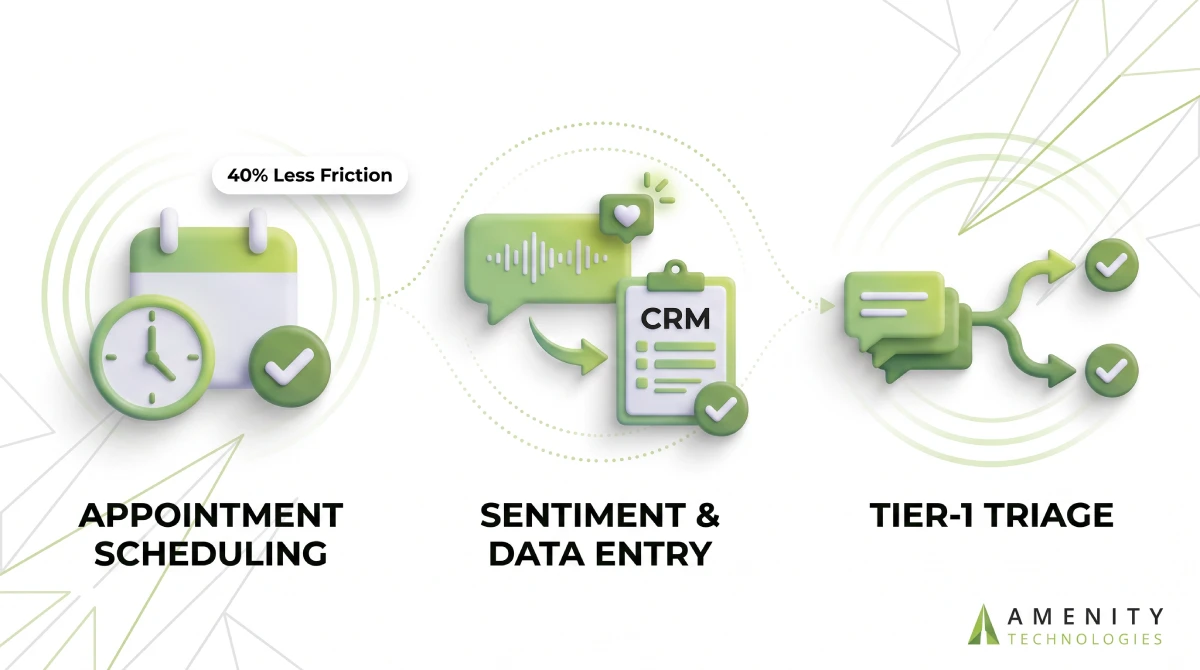
Complex Appointment Scheduling: Where AI Voice Assistant Development Either Breaks or Proves Its Worth
Scheduling sounds simple. But it isn’t.
Scheduling logic is often siloed across disparate departments. Time slots carry dependencies. Human availability fluctuates. One wrong booking triggers operational chaos.
AI voice assistant development in this domain requires layered reasoning:
- Contextual slot validation: Real-time access to calendars, buffers, and dependencies.
- Latent intent mapping: Recognizing “I need to reschedule” vs “I might cancel”.
- Constraint resolution: Location, resource, specialist, and urgency.
- Sub-second conversational flow: No dead air during backend calls.
Our experience with healthcare enterprise deployments reveals that the majority of the bots didn’t have real-time access to the surgeon’s calendar.
Architecture dictates success here. A capable voice AI agent doesn’t just book, it negotiates availability dynamically, offers alternatives proactively, and confirms with human-like precision. Systems built this way reduce scheduling friction by over 40%, not because they are faster, but because they are context-aware.
Scheduling exposes weak systems instantly. Optimized systems provide a frictionless, invisible user experience.
Post-Call Sentiment & Data Entry: The AI Voice Bot as a Silent Auditor That Never Misses
Most enterprises underestimate what happens after the call ends. Notes get skipped. Sentiment gets misread. CRM-sync latency introduces data gaps that compound over time.
An advanced voice AI agent doesn’t stop listening when the customer hangs up. It transitions roles.
Vocal tonality, cadence, and paralinguistic cues are analyzed via Emotion AI. They extract sentiment gradients, not just “positive” or “negative,” but escalation risk, compliance flags, and churn signals. This happens in seconds.
Asynchronous CRM write-back occurs automatically. No agent dependency. No inconsistency. Structured summaries populate CRM systems instantly, eliminating manual input errors that plague support teams.
Understand that a voice bot without a fallback to a human agent isn’t a strategy; it’s a liability.
Organizations deploying this model see sharper insights. Patterns emerge faster. Supervisors stop guessing. The voice AI agent becomes an operational lens, not just a support layer.
High-Volume Tier-1 Triage: Where the Best AI Voice Assistants for Customer Support Automation 2026 Actually Compete
Unmanaged call volume creates systemic bottlenecks in traditional support models. Complexity isn’t the main culprit here.
Tier-1 queries repeat constantly, including password resets, order status checks, basic troubleshooting. When human agents handle these repeatedly, bottlenecks start to build, and hiring alone doesn’t solve it.
This is where the best AI voice assistants for customer support automation 2026 start to stand out.
When effectively engineered for customer support automation, AI voice assistants operate differently:
- Zero-shot resolution: Handling unseen queries without scripted training
- Intent clustering: Grouping similar requests dynamically for faster resolution
- Adaptive dialogue paths: No rigorous flows, only guided probabilities
- Real-time escalation triggers: Detecting when automation should step aside
While low latency is crucial, high-fidelity intent resolution is paramount. Sub-second TTS response keeps interactions fluid, preventing user drop-offs mid-call.
These systems do not replace agents. They protect them. They absorb repetitive load, allowing human teams to focus on revenue-impacting or emotionally sensitive interactions.
In the end, if it doesn’t feel like automation at all, the Tier-1 automation is done right.
The Architecture of Trust: Voice Biometrics, Security Layers, and Why Compliance Now Shapes Experience
Voice interactions involve identity risk. Fraud attempts increase as systems become more capable. Enterprises ignoring this layer build fragile ecosystems.
The implementation of passive voice biometrics represents a significant security upgrade. Passive authentication analyzes vocal signatures in real time. There’s no friction, PINs, or security questions. Identity verification happens during conversation.
Security stacks extend further:
- End-to-end encryption for voice streams
- Real-time anomaly detection for behavioral deviations
- Adaptive risk scoring based on interaction patterns
- Regulatory alignment with evolving data protection frameworks
Architecture dictates whether security feels seamless or obstructive. Systems designed correctly embed protection into interaction flow. Systems designed poorly interrupt users constantly.
Amenity Technologies approaches this differently. Security becomes part of conversation design, not an afterthought layered on top.
Secure voice systems build confidence quietly. Insecure ones create friction loudly.
The Integration Gap: Why Your AI Voice Bot Is Only as Good as the Systems It Talks To
Most systems claim to be “connected.” Reality looks different. Data arrives late. Status updates don’t reflect the current state. A customer asks a simple question: “Where’s my order?”, and the AI voice bot responds with yesterday’s answer. Trust drops instantly.
Real integration behaves differently. It moves information as it changes, not in batches. It keeps conversations aligned with live system states. It keeps track of the context across touchpoints without making the user repeat themselves. That level of cohesion doesn’t come from plugging into APIs, it comes from designing how systems talk under pressure.
Architecture decisions here are irreversible. Teams that delay this layer end up stitching systems together later, introducing hidden latency, brittle dependencies, and inconsistent outputs that surface during peak demand.
Solve integration early, and everything compounds. Ignore it, and even the most advanced AI voice bot starts sounding unreliable.
The Amenity Advantage: Moving from Automation to Interaction
Years of AI voice assistant development don’t translate into theory, they show up in how systems behave under pressure. Latent intent isn’t treated as a buzzword here; it’s modeled against your actual customer conversations, your edge cases, your failure points. Integration isn’t “connected”, it’s deeply wired into the systems your teams already depend on, so responses don’t lag behind reality.
Some things matter more than others. Real-time data flow. Clean handoffs. Systems that don’t break when queries get messy.
Voice, in this model, stops being a support layer bolted onto operations. It becomes part of how decisions move, how customers experience your brand in motion.
That shift is where most enterprises hesitate.
The ones that don’t tend to build something harder to replicate, interaction ecosystems that absorb volume, adapt without retraining cycles, and keep improving quietly in the background while teams focus on work that actually requires judgment.
Ready to move beyond surface-level automation? Let’s design an AI voice bot that actually understands your customers, integrates with your systems, and performs under real pressure.
Connect with Amenity Technologies and start building a voice strategy that delivers, not just responds.
FAQs
Q.1. Will integrating a voice bot disrupt our existing systems?
A: It usually won’t affect your existing systems if it is done correctly. Robust AI voice assistant development maintains deep integration with CRM, ERP, and ticketing systems without any operational downtime.
Q.2. How fast does an AI voice bot respond during live conversations?
A: Enterprise-grade bots deliver sub-second TTS response times, eliminating awkward pauses and maintaining natural conversational flow.
Q.3. How accurate is sentiment detection in voice interactions?
A: Emotion AI models usually succeed in analyzing tone, pacing, and speech patterns to detect nuanced sentiment far beyond basic positive/negative tagging.