

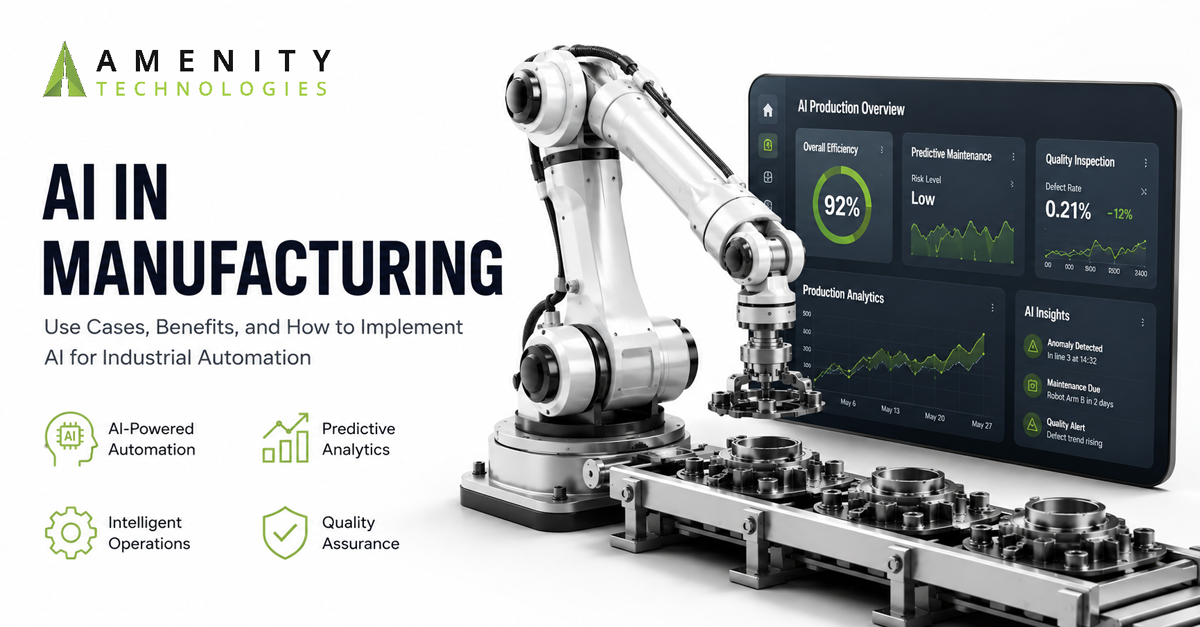
Walk into most plants today and you’ll see dashboards everywhere. Data is being collected nonstop through Sensors, PLCs, and SCADA systems. Yet decisions on the floor still rely on instinct.
Do you know why this happens? This fragmentation occurs because data remains siloed. Maintenance, production, and quality each operating in separate systems.
We’ve seen this across the Gujarat Industrial Belt industrial plants investing heavily in digital tools but still reacting to problems instead of anticipating them.
(Expert Note: We’ve seen plants where 70% of collected data is never even looked at. Don’t let that be you.)
That’s the gap AI for manufacturing is trying to bridge. This isn’t done by adding more data but by making it usable.
What AI in Manufacturing Actually Means
Let’s keep it simple. AI in manufacturing refers to systems that analyze machine data, detect patterns, and make decisions or recommendations without constant human input.
That’s it. No magic. No black box thinking. You just feed it operational data including temperature, vibration, and cycle time. And it starts identifying what “normal” looks like. Then it flags when things drift.
The real value isn’t automation. It’s early awareness. When you know something is going wrong before it actually stops production, you’re no longer reacting. You’re actually planning.
Why Most AI Initiatives Stall Before They Reach the Floor
Ever noticed how many AI projects stay stuck in pilot mode? It’s rare because the models don’t work. It’s because the shop floor doesn’t trust them.
Data quality is inconsistent. Systems don’t talk to each other. And operators don’t see immediate value. So the project slows down. We’ve walked into plants where dashboards look impressive, but no one actually uses them during a shift.
That’s the difference between building for presentations and building for operations. AI industrial automation only works when it fits into daily workflows, not when it sits outside them.
Where AI in Manufacturing Actually Delivers Measurable Benefits
Predictive Maintenance: Before the Noise Becomes a Breakdown
You can usually hear failure coming. It could be a bearing that starts to hum differently, heat building up slowly, or just something feeling off. But by the time you notice, you’re already late.
Predictive maintenance changes that window. Using vibration analysis and thermal imaging, systems track early signals including tiny shifts that aren’t visible yet.
Bearings, motors, and pumps, all of these leave traces. AI picks it up early. So instead of reacting to failure, you practically schedule it. That’s how downtime drops.
If you’re not sure where to begin, start with a shop-floor audit. Identify the machines that fail most, and build from there.
AI Vision for Quality: Consistency Without Fatigue
Manual inspection works; until it doesn’t. After hours on the line, even experienced operators miss things. It’s not a skill. It’s fatigue.
AI vision doesn’t get tired. Every unit is checked. Same way. Every time.
Surface defects, alignment, and dimensional variation are all captured consistently. No drop in attention.
We’ve seen rejection leakage reduce just by shifting inspection to vision systems. But setup matters more than the model.
Poor lighting, bad camera angles, and weak training data need to be fixed first. Otherwise, even the best system won’t help.
The ROI of Industrial Automation: Where It Actually Shows
If we are talking about numbers, the biggest impact comes from two areas:
1. OEE (Overall Equipment Effectiveness)
Even slight improvements here lead to significant gains.
2. Unplanned Downtime
Reducing unexpected failures directly affects results.
Over time, we’ve found:
- Downtime reduced by 20–30%
- Maintenance costs drop noticeably
- Production stability improve within months
But ROI doesn’t come from AI alone. It comes from applying it in the right place.
Moving AI Projects Beyond the Pilot Phase
Ever seen a project that looks good in a presentation but never makes it to operations? It happens often.
The model works. The dashboard looks clean. But no one uses it during a shift. Why? Because the setup doesn’t match real workflows. Data isn’t reliable. Alerts aren’t trusted. Operators fall back on experience instead.
We’ve walked into plants where systems were installed, but bypassed. That’s the real failure point.
AI industrial automation only works when it fits into the way teams already operate. If it adds steps instead of removing them, adoption drops quickly.
Where AI Actually Adds Value (And Where It Doesn’t)
Not everything needs AI. That’s where many plants go wrong. They try to apply it everywhere, and end up seeing no clear result. One should begin with:
- Machines that fail often
- Repetitive inspection tasks
- High energy consumption processes
That’s where AI for industrial use actually pays off. We’ve seen teams begin with low-impact areas just to “test AI.” It rarely works. So, it is a better idea to pick a problem that is negatively impacting your operations. And solve it first.
The Implementation Secret Weapon: What Works Step-by-Step
Let’s break this down the way it actually happens on the floor.
Audit
Identify the data you actually have, not what’s planned, but what is genuinely usable.
Data Cleaning
Most datasets are messy. Missing logs, inconsistent formats. Clean this early.
Model Selection
Avoid over-engineering the initial deployment. Solve one clear issue first.
PLC Integration
This is where most delays happen. Systems need to talk to machines.
Human-in-the-Loop
If operators don’t trust it, it won’t be used. Simple as that.
Why PLC Integration Is Where Projects Stall
This part doesn’t get enough attention. Getting insights is one thing. But, making them usable on the floor is something different.
PLCs aren’t built for flexibility.
You’re dealing with:
- Legacy protocols
- Vendor-specific logic
- Limited real-time adaptability
This is where many AI manufacturing companies struggle.
If the system doesn’t connect properly, it becomes another dashboard, nothing more. And operators ignore dashboards that don’t help at the moment.
The Heavy Hitters and Their Limitations
Companies such as Siemens, GE, and IBM have already built strong ecosystems revolving around industrial AI because that means scale, stability, and proven systems.
However, they also come with complexity, which involves long deployment cycles. rigid architectures, and high upfront commitment.
For many plants, especially mid-sized ones, that becomes a barrier. This is where agile players step in. At Amenity Technologies, we focus on:
- Faster deployment cycles
- Custom-fit solutions
- Integration with existing systems without overhaul
Different approach. Same outcome; just more practical.
Scaling AI Without Breaking Operations
Once the first use case works, the next challenge is scaling. This is where many plants struggle again. Because what worked in one line doesn’t always work in another.
Different machines. Different conditions. Scaling requires:
- Standardization of data
- Repeatable integration models
- Clear ownership
Without this, expansion slows down.
Final Thought: The Shop Floor Decides, Not the Boardroom
You can plan everything at the top level. But if it doesn’t work on the floor, it doesn’t work at all.
AI in manufacturing isn’t about dashboards. It’s about whether operators trust what they see.
Whether maintenance teams act on alerts or production actually improves at that particular interval is the real test.
If you’re exploring AI for manufacturing, don’t make the haste decision of starting with a full-scale rollout.
Adopt a modular rollout strategy. One machine. One problem.
– Book a shop-floor audit with Amenity Technologies.
– Or work with us to calculate ROI before implementation.
This is how you move from a mere idea to significant impact.
FAQs
Q.1. How do you choose the first use case for AI?
A: Initiate with zones where downtime or inefficiency is clearly visible. The more obvious the problem, the easier it will be to track outcomes.
Q.2. Do existing machines need to be replaced for AI implementation?
A: Not particularly. Most setups work smoothly with existing machines using sensors and data integration. Replacement is usually not required unless your systems are extremely outdated.
Q.3. How long does it take to see ROI from AI in manufacturing?A: In most cases, results start to appear within a few months, especially in predictive maintenance. Full ROI usually relies on how well the system is integrated into your daily operations.
