

Support costs usually don’t become a big problem suddenly. They grow over time.
Increased user adoption leads to more queries.
More features leads to more confusion.
More customers leads to more expectations.
At some point, teams notice it. Response times increase. Hiring expands. Support queues stretch longer than expected. The usual fix is to add more people. It works for a while. Then the cycle repeats.
This is where a chatbot for SaaS starts to shift the equation. Not by replacing support teams, but by removing the layer of repetition that causes support costs to scale faster than the business itself.
Where Support Costs Actually Come From
Most SaaS and B2B teams assume support costs are driven by complexity. In reality, they’re driven by repetition.
A large portion of incoming queries tends to fall into a few categories:
- Account-related questions
- Onboarding confusion
- Feature usage clarifications
- Basic troubleshooting
These aren’t difficult problems. They’re frequent ones. And that’s the reason why these operations are expensive. Because every repeated question handled manually adds to operational cost; without adding new value.
This is why conversations around how AI chatbots can be beneficial for SaaS businesses tend to focus less on advanced capabilities and more on handling high-frequency interactions. The objective is not to automate everything, but to reduce the number of times the same work is done.
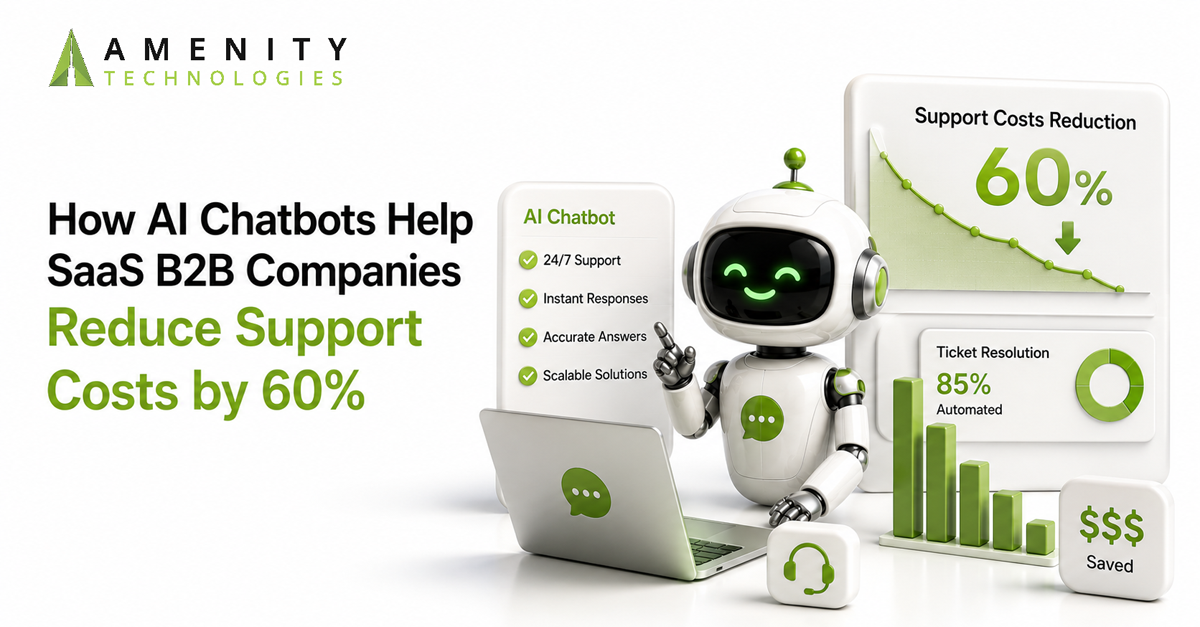
What the 60% Cost Reduction Really Represents
The framework for achieving a 60% reduction can be misleading if taken at face value. It does not imply cutting teams or eliminating support functions. Instead, it reflects a shift in how support volume is handled.
When an AI chatbot for SaaS companies is introduced effectively, a large portion of incoming queries never reaches human agents. Routine questions are answered instantly, without tickets being created or queues forming.
Over time, this changes how support resources are used. Teams are no longer occupied with repetitive tasks and can focus on issues that require investigation, judgment, or customer context.
The cost reduction comes from this redistribution of effort. Fewer resources are required to manage the same volume of users. It isn’t because demand decreases, but because the system handles it differently.
Removing the First Layer of Support Friction
In most SaaS products, the first interaction with support is rarely complex. It’s usually something small. A missing step during onboarding. A feature that isn’t immediately clear. A setting that behaves differently than expected.
Individually, these aren’t difficult to resolve. But they happen often enough to create pressure on support teams.
What virtual support bots do here is not replace support, but absorb that first layer. Instead of routing every query through an agent, users get an immediate response for things that don’t require investigation. That changes how support queues behave. They stop building up around basic issues.
The system feels lighter; not because demand drops, but because the simplest interactions are no longer adding weight to it.
At this stage, many SaaS teams begin evaluating how to implement this shift without disrupting existing workflows. This is where working with a partner like Amenity Technologies helps—focusing on practical chatbot integration that aligns with real support environments rather than adding another layer of tools.
Why SaaS and B2B See Faster Results
Chatbots tend to work better in environments where patterns already exist. SaaS and B2B products naturally create those patterns. Users go through similar onboarding steps. They use the same features. They run into the same points of confusion.
Over time, this creates a predictable layer of queries. That’s why even a simple AI chatbot for SaaS companies starts showing results early. It doesn’t need to handle everything. It only needs to handle what repeats.
This is also why teams exploring recommended live chat platforms for SaaS businesses are often looking beyond communication; they’re trying to manage that repetition more efficiently.
What Changes Inside Support Teams
The shift inside support teams is usually noticeable within a few weeks of deployment. Not in size, but in how time is spent.
Without chatbots, a large part of the day goes into answering variations of the same questions. It’s fast work, but repetitive. And over time, it limits how much attention can be given to more complex issues.
Once that layer is reduced, something changes. Agents start dealing with fewer conversations, but the ones they handle require more context. More attention. More thinking.
The work slows down in a good way. Instead of clearing queues, teams start resolving problems.
The Overlooked Expense: Time and Operational Drag
Support expenses aren’t just about how many people are on the team. It’s also about how their time gets used.
A lot of that time goes into small, repeated actions including checking the same documentation, switching between tools, answering familiar questions. None of these feel expensive in isolation.
But they happen constantly. Chatbots don’t eliminate work. They remove the need for that work to repeat. And once repetition drops, something else happens quietly, teams stop feeling rushed.
There’s less switching, less context loss, and fewer interruptions. Which, over time, changes how efficiently the entire support function runs.
Where AI Agents Fit in the Support Workflow
AI Agents don’t sit in the middle of support systems. They sit at the front.
They are in charge of the first point of interaction. It is the point where most queries are still simple. If the question is clear and repeatable, it gets resolved immediately. If it isn’t, it moves forward to a human agent.
That boundary matters because it keeps the system balanced. Automation handles what it can handle reliably. Everything else stays where judgment is needed.
When this balance is right, the system feels faster without becoming rigid.
Real Impact: Where Cost Reduction Becomes Visible
The effect doesn’t show up as a single metric at first. It shows up in patterns.
- Fewer tickets created for the same issues.
- Less follow-up on basic queries.
- Shorter queues during peak usage.
During onboarding, for example, new users often need the same guidance. When that guidance is handled through chat instead of support tickets, the difference becomes visible quickly.
This is also where AI chatbots for SaaS lead generation strategies begin overlapping with support. The same interaction that answers a question can guide a user toward the next step, without needing a separate process.
Why Some Chatbot Implementations Fail to Deliver Results
When chatbots don’t work, it’s rare because the technology isn’t capable. It’s usually because too much is expected too early.
Trying to automate complex queries from the start creates gaps. Users ask something slightly outside the expected flow, and the system doesn’t respond well.
Another common issue is weak integration. If the chatbot doesn’t connect properly to real data, responses feel generic. And once that happens, users stop trusting it. The implementations that work tend to be narrower at the beginning. They focus on what repeats. Let that layer stabilize. Then expand.
Final Thoughts: Cost Reduction Is an Outcome of Better Systems
AI chatbots don’t directly reduce costs. They reduce unnecessary interactions. And once those interactions are removed, everything else adjusts including time, workload, and response cycles.
In SaaS and B2B environments, where growth usually brings more support demand, that adjustment matters. Because it allows the system to scale without constantly needing to expand. And in most cases, that’s the real goal.
For SaaS and B2B teams looking to apply this in a practical way, the focus usually shifts from tools to execution. At Amenity Technologies, the approach stays grounded in real support workflows, helping teams introduce AI chatbots without disrupting how support already functions.
FAQs
Q.1. How do you identify which support queries should be automated first?
A: Start by looking at volume, not complexity. The queries that repeat the most (no matter how simple) are usually the best candidates. Once those are handled, the impact becomes visible quickly.
Q.2. Is the 60% cost reduction realistic for all SaaS companies?
A: Not always. The numbers actually depend on how much of the total support volume is repetitive. Companies with structured products and predictable queries tend to see higher reductions compared to those with highly complex or custom use cases.
Q.3. What is the biggest factor that determines cost reduction success?A: The integration of AI assistants with real systems and clarity of use cases. If the chatbot can access accurate data and handle high-frequency queries, cost reduction becomes consistent.
