

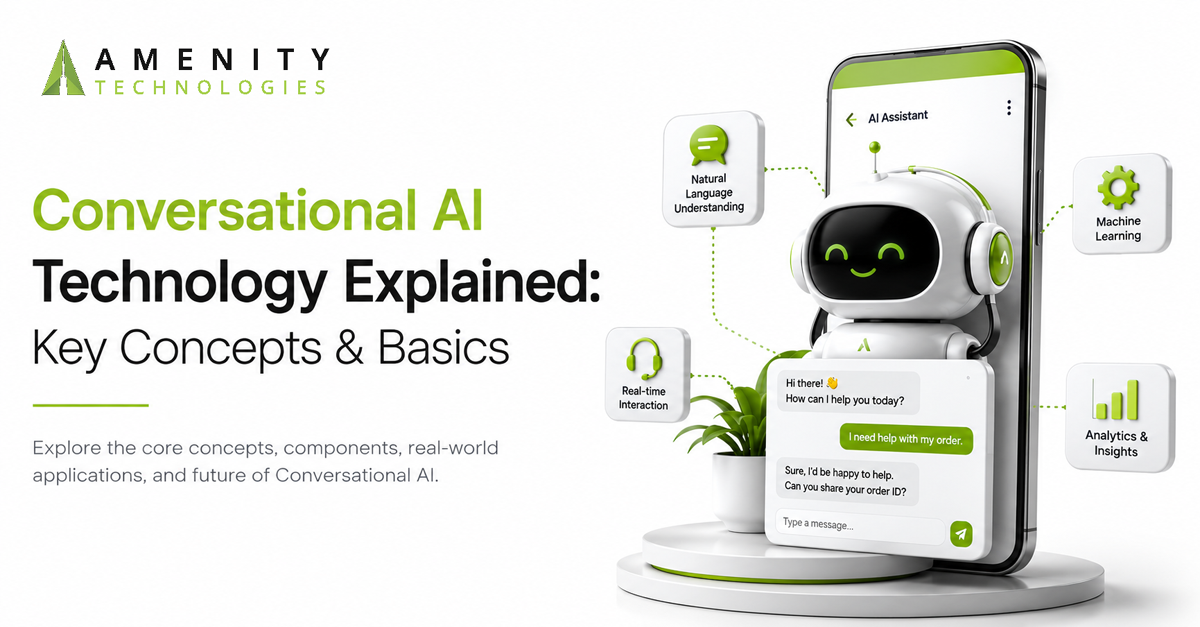
Most people hear “conversational AI” and immediately think of chatbots.
That’s not wrong. It’s just incomplete.
Because the real shift isn’t about chatbots; it’s about how systems respond to people. For a long time, users had to adapt to software. Click this. Search for that. Navigate menus just to find basic information. Conversational AI flips that.
Instead of learning the system, you just ask. And the system accurately interprets your intent.
That may sound simple. But it changes everything about how digital interactions feel.
Today, we’ll explore the topic of “what is conversational AI?”, explaining how it works, key concepts, and real-world examples across industries.
So What Does “Conversational AI” Actually Mean?
At a surface level, it’s easy to define.
A system that understands and responds to human language. But that definition misses the important part.
What makes conversational AI different is not the response; it’s the interpretation.
People rarely ask things the same way twice.
Someone might say:
– “Check my order status”
– “Where’s my delivery?”
– “Has my package shipped yet?”
A basic system treats these as different inputs. On the other hand, a conversational system sees them as having the same underlying intent.
That’s where the difference sits. Not in the answer, but in how the system understands the question.
Why Traditional Systems Always Felt Slightly Frustrating
Before AI assistants, most systems followed structure.
Businesses had to:
- Choose the right option
- Use the right keywords
- Follow the expected flow
If they didn’t, things might not turn out the way they expect.
We’ve all seen it. You type something slightly different; and suddenly the system doesn’t “understand.” Not because your request was unclear, but because it didn’t match the system’s predefined structure.
That’s the gap conversational AI tries to close. Instead of forcing structure on users, it absorbs variation. Ultimately, it doesn’t eliminate friction completely; but it reduces it.
What Actually Happens Behind the Scenes
From the outside, it feels like a conversation. But, behind the scenes, it’s not that simple.
When someone types a message, the system doesn’t just read it; it breaks it down. Words, meaning, context. It tries to figure out what the user is really asking for.
Then it decides how to respond.
– Sometimes it answers directly.
– Sometimes it asks a follow-up question.
– Sometimes it pulls data from another system.
This entire sequence occurs in a fraction of a second.
The important part isn’t the process; it’s the outcome. If the user doesn’t have to think about it, it’s working.
Where You’re Already Using It (Without Noticing)
Virtual support bot isn’t something new being introduced. It’s already in use; quietly.
– Customer support chats that don’t make you wait.
– Voice assistants that understand slightly messy commands.
– Banking apps that answer questions instead of redirecting you.
Even ecommerce stores are using it to guide product searches or handle basic queries. In many cases, this shows up as a conversational AI chatbot for Ecommerce, helping users find products, track orders, or resolve simple issues without leaving the page.
Most users don’t wait and think, “this is conversational AI.”
They just notice: “This was easier than expected.”
That’s usually the signal.
The Chatbot vs Conversational AI Difference (This Is Where Most Get It Wrong)
This part often gets mixed up. Remember, not every chatbot is conversational AI.
Older AI assistants follow scripts. They’re built around fixed flows:
If user says X – respond with Y
If user clicks option A – show option B
This works until the conversation shifts slightly. The user asks something that isn’t structured. Then, the conversation breaks.
Conversational AI is built differently. It doesn’t rely on strict paths. It adapts. It interprets. It adjusts responses based on how the user communicates.
That’s why some chat experiences feel smooth; and others feel frustrating.
What we learn here is that there’s the same interface but different underlying logic.
Where Automated Chat Assistant Actually Adds Value (And Where It Doesn’t)
Automated Chat Assistant works best in environments where:
– questions repeat
– responses need to be quick
– interaction volume is high
Customer support is the obvious example.
But it also shows up in:
- Banking queries
- Appointment scheduling
- Product assistance
- Internal helpdesks
Now here’s the part people don’t talk about enough since it doesn’t work everywhere.
In case a situation requires deep judgment, complex decision-making, or emotional nuance, automation starts to feel out of place.
That’s why the goal isn’t to replace everything with automation. It’s to handle what can be handled consistently.
The Role of Learning (Why It Gets Better Over Time)
One thing that separates conversational AI from traditional systems is learning. It doesn’t learn everything in a dramatic, overnight way. But gradually.
Every interaction adds context. Patterns begin to form. The system starts recognizing variations it hasn’t seen earlier.
At first, responses may feel restricted. But, after enough interactions, they become more accurate.
This is why early versions often feel “okay,” while later versions feel significantly better to users.
The system never changes its purpose. It’s improving its understanding.
Where Things Start to Break Down
Even well-built systems run into issues. And usually, it’s not because the technology failed. It’s because of how it was used.
One common issue is over-reliance. If everything is pushed into automation, users feel stuck. Especially when they need something slightly outside the system’s scope.
Another issue is poor design. If the system doesn’t handle unclear inputs well, users repeat themselves. That’s where frustration builds.
Then there’s integration. If the AI can’t access real data, it gives generic responses. And users notice that quickly.
Another issue is poor design. If the system doesn’t handle unclear inputs well, users repeat themselves. That’s where frustration builds. In many cases, reviewing an AI chatbot conversations archive helps identify exactly where conversations fail or lose context.
So the problem isn’t conversational AI itself. It’s expecting it to do more than it’s actually trained for, or setting it up without the right context.
Why Businesses Are Moving Toward Conversational Agents Anyway
Despite the limitations it possesses, AI adoption is growing. This isn’t because it’s perfect but because it solves a specific problem well. And that is volume. It handles large numbers of interactions without increasing workload.
Instead of scaling teams endlessly, businesses use conversational systems to manage the first layer of interaction. Then escalate when needed.
It’s not about replacing people. It’s about redistributing effort.
If You’re Thinking About Using It, Start Here
Most implementations fail for one reason. They try to do too much.
A better approach is beginning with a small step.
Begin with:
One type of interaction
One common use case
One clear objective
Let the system handle this consistently first. Then think of expanding.
This approach works better because it’s easier to measure, easier to improve, and easier to trust.
Conversational AI improves with use, but only if it’s introduced in a controlled way.
Final Thoughts: It’s Less About AI, More About Interaction
The term “conversational AI” makes it sound like a technical shift. In reality, it’s more of an interaction shift.
People don’t want to navigate systems anymore. They want to communicate with them.
That’s what this conversational technology enables.
When it works, it feels natural.
When it doesn’t, it feels obvious.
And over time, the expectation changes.
Not “how do I use this system?”
But “why can’t I just ask?”
That’s where things are heading.
Are you planning to invest in the conversational AI chatbot development service? If so, contact Amenity Technologies. Our support team will assist you make the right choice for your automation requirements while ensuring you get maximum benefits out of the AI solutions.
FAQs
Q.1. How is conversational AI different from automation tools we already use?
A: Most automation tools follow fixed rules: you set conditions, and the system responds accordingly. Conversational AI is built differently. It doesn’t depend on exact inputs. Instead, it interprets what the user is trying to convey, even if the wording changes. That flexibility is what allows it to handle real conversations rather than structured commands.
Q.2. Can conversational AI handle complex, multi-step conversations?
A: It can handle complicated, multi-step conversations, but there are limitations to keep in mind. If the tool is designed well, it can manage follow-up questions and maintain context within a specific conversation. However, once communication becomes highly complex or requires judgment, human intervention is still necessary. The goal isn’t to replace those scenarios but to minimize the load before they occur.
Q.3. What makes a conversational AI system feel natural instead of robotic?
A: It usually comes down to two things: flexibility and context. If the system can understand variations in language and respond without forcing users into rigid flows, the interaction feels natural. On the other hand, if users have to repeat themselves or adjust how they speak, the experience quickly feels mechanical.
