

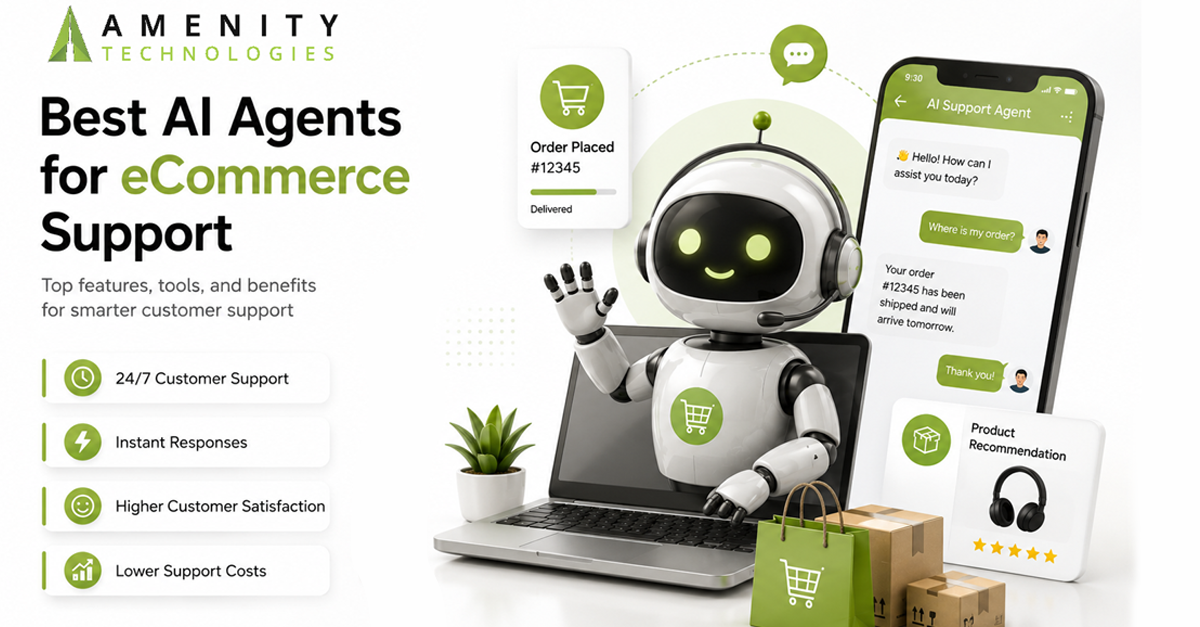
Customer support in Ecommerce has quietly become one of the most demanding parts of the business.
Simple FAQ retrieval is no longer a competitive advantage. Customers always expect immediate responses from businesses. They want precise information and support that feels consistent; regardless of the time they reach out. That’s tough to maintain with human teams alone, especially as order volumes grow.
This is where AI agents for Ecommerce support have begun to step in.
Not as replacements, but as support layers that handle the volume, the repetition, and the speed. The real question isn’t whether businesses should use them anymore. It’s which ones actually make a difference; and which ones just add another tool to manage.
What Makes an AI Agent “Good” for Ecommerce?
Not all perform the same, even if they seem similar on the surface.
Some respond quickly but lack context. Others integrate well but struggle with conversation flow. A few do both well; but only within certain limits.
So what actually defines a strong conversational AI for Ecommerce? This usually comes down to three things:
- How well it understands customer intent
- How easily it connects with existing systems
- How reliably it handles real-world queries
Speed alone isn’t enough. Accuracy matters more.
A chatbot that replies instantly but gives vague or incorrect answers creates more problems than it solves. The better systems tend to feel less like automation and more like guided assistance.
The Role of AI Agents in Day-to-Day Ecommerce Support
Most Ecommerce support queries have a predefined pattern.
Customers want to know:
- Where their order is
- When it will arrive
- How to return or exchange a product
- Whether something is in stock
These are not complex questions. But they come in high volume.
This is where Ecommerce customer support automation proves useful. It handles these repetitive interactions consistently, without delays or fatigue. That alone reduces pressure on support teams.
But the role doesn’t stop there. More cutting-edge tools can navigate users through product discovery, suggest alternative options, and even assist during the checkout process. In those cases, the AI agent becomes part of the customer journey; not just the support system.
Popular Types of AI Agents Used in Ecommerce
When businesses look for the “best” AI agents, they often expect a list of tools. In reality, what matters more is understanding how each type functions and where it fits in your support flow.
Because most Ecommerce setups don’t rely on just one; they rely on a mix.
1. Customer Support Assistants (The Backbone)
This is usually the first layer of automation.
These agents are built to handle repetitive queries; order status, return policies, delivery timelines. There’s nothing complicated, but the handling of high-velocity ticket spikes.
Features you’ll usually see:
- Real-time order tracking responses
- Predefined FAQ managing with contextual understanding
- Integration with shipping and order systems
- Basic escalation when queries go beyond scope
Common tools used here:
Platforms like Intercom, Zendesk AI, Freshdesk AI, and Tidio are often used to set up these assistants. They’re widely adopted because they connect easily with Ecommerce stacks.
Where the real benefit shows:
Support teams stop dealing with the same questions repeatedly. Response times drop almost immediately. More importantly, customers don’t have to wait for simple answers.
It is the operational bedrock of scalable support.
2. Conversational Sales Assistants (Where Support Meets Revenue)
This is the intersection of Support and Conversational Commerce. A lot of customers don’t come with clear intent. They browse, compare, hesitate; and sometimes leave without asking a single question.
This is where conversational sales assistants become helpful. Instead of waiting for queries, it steps in during that uncertainty.
What it actually does (in practice):
- Responds when users seem stuck or inactive
- Helps narrow down choices instead of listing everything
- Answers product-specific doubts in real time
- Suggests alternatives when something isn’t available
The interaction feels less like support and more like guidance.
Tools you’ll often see used:
Platforms such as Drift or Shopify-based AI chat layers are commonly used here, especially for brands that want tighter control over product conversations. Some businesses go a step further and build custom flows; mainly to match how their customers actually shop.
Where the benefit shows up:
- Fewer drop-offs.
- More completed sessions.
- Less hesitation during checkout.
The assistant doesn’t push the customer; it removes the pause. And in Ecommerce, that small shift makes a bigger difference than most features.
3. AI Voice Agents (Handling Volume at Scale)
Not everyone wants to chat. Some customers just call; especially when something feels off. A delayed order, a payment issue, or just confusion that’s easier to explain out loud than type.
That’s usually where AI voice agents for Ecommerce start becoming useful.
They don’t replace calls. They just take the pressure off the obvious ones.
Core Agentic Capabilities include:
- Handles basic conversations using natural voice (not keypad menus)
- Can check order status or delivery updates instantly
- Routes calls based on what the customer is trying to do
- Connects with backend systems for real data (not scripted replies)
- Passes the call to a human when things go off track
Common tools used here:
You’ll usually see setups built on tools like Twilio Voice AI or similar voice platforms. Most teams don’t use them standalone; they plug them into existing support systems so the responses actually make sense.
Where the real benefit shows:
The difference is mostly felt in volume.
- Fewer people waiting.
- Fewer repeated conversations.
- Less pressure on support teams during peak hours.
It doesn’t suddenly “improve support quality” overnight.
4. Hybrid AI + Human Systems (The Practical Approach)
This is what most mature Ecommerce businesses eventually move toward.
Instead of trying to automate everything, they combine AI speed with human judgment.
How these systems usually work:
- AI handles first-level queries
- Detects complexity or uncertainty
- Seamlessly transfers to a human agent
- Passes full conversation context (no repetition)
Tools that support this:
Zendesk AI, Intercom, and Gorgias are commonly used in hybrid setups because they allow smooth handoffs between AI and human agents.
Why this approach works best:
Because not every situation can be automated.
Customers get quick answers when possible; and human support when needed. That balance enhances both efficiency and satisfaction.
It’s less about replacing people and more about using them where they matter most.
Choosing the Right AI Agent: What to Focus On
When you’re shortlisting AI agents for Ecommerce operations, the process doesn’t need to be complicated.
But it does need to be focused.
Start with questions like:
– What type of queries take up the most time?
– Where do users face delays the most?
– Which interactions can be handled without involving human agents?
From there, evaluate how well different solutions address those specific requirements.
It’s not just about selecting the “best” tool. It’s more about finding the right fit that removes the bottlenecks in your Ecommerce business.
Final Thoughts: The Best AI Agent Is the One That Feels Invisible
The most effective AI agents don’t stand out.
Customers don’t think about them. They just want to get the answers they seek, quickly and clearly. That’s the most important job for Ecommerce businesses.
In Ecommerce, support is no longer just a reactive function. It’s part of the overall customer experience. Digital assistants, when implemented correctly, help maintain that experience at scale.
So the question isn’t just which AI agents are best.
It’s which ones fit naturally into your workflow; and quietly make everything run smoother.
If you find yourself surrounded by multiple questions related to AI agents for Ecommerce, you can reach out to Amenity Technologies. We’ll provide tailored support to help you stay on the right track and invest in the right solutions for your Ecommerce business’s operational consistency.
FAQs
Q.1. Which AI agent is actually best for ecommerce support?
A: There isn’t a single “best” option that works for every business. Selection is contingent upon where your support load is coming from. If most queries are about orders and returns, a basic support assistant does the job. If customers hesitate before buying, a conversational sales assistant becomes more useful. In most cases, businesses end up using a mix rather than relying on one type.
Q.2. How do AI agents improve customer experience in ecommerce?
A: Mostly by removing waiting time. Customers don’t want long responses; they want quick, clear answers. Customer support bots can help by responding instantly, especially for common concerns such as order tracking or return policies. It’s not about making support feel “advanced.” It’s about making it feel effortless.
Q.3. Can AI agents help increase sales or just support customers?A: They can do both, depending on how they’re trained and used in practice. Support-focused agents reduce workload. Sales-focused agents guide customers during decision-making. For many ecommerce brands, even small improvements in guidance can reduce drop-offs during checkout.
