

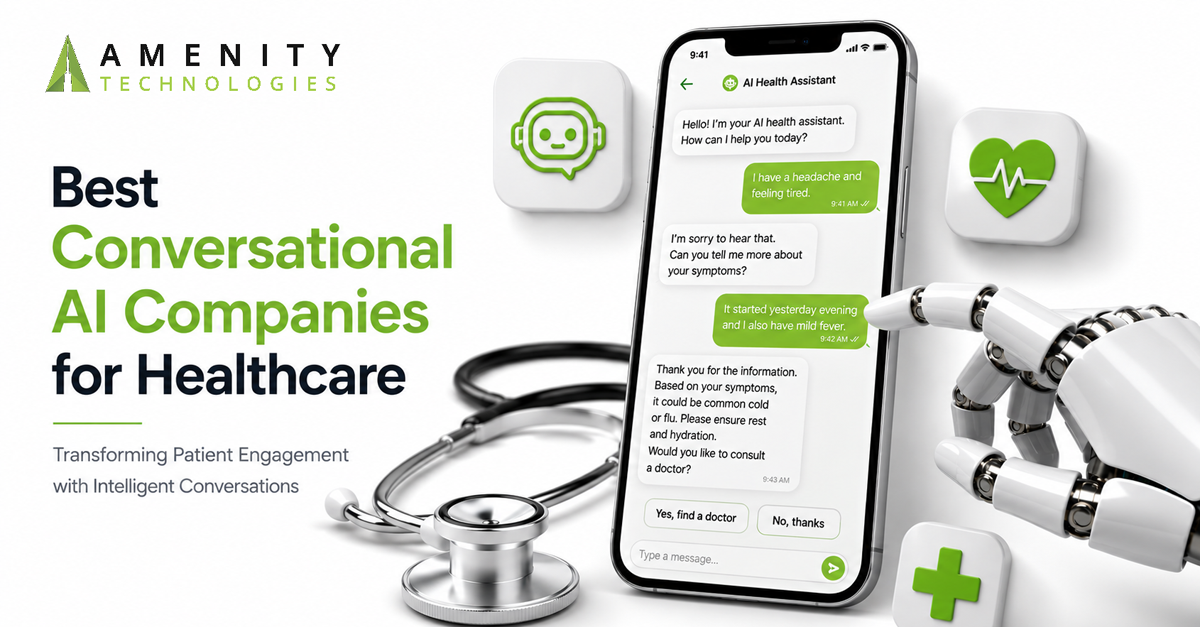
Conversational AI in healthcare is not only about automation; it’s more about reliability.
Unlike other industries like retail or SaaS environments, healthcare ecosystems require HIPAA-compliant data architecture and PHI security. A missed appointment, a delayed response, or inaccurate information isn’t just a minor inconvenience here.
That’s why shortlisting the optimal conversational AI companies for healthcare in the market and partnering with a reliable provider is an important decision. It is more than choosing the most advanced technology.
Healthcare organizations evaluating conversational AI providers usually look beyond features. They focus on how well the system integrates into existing operations, its data governance and sovereignty protocols, and whether it can be trusted in real-world scenarios, not just demos.
This guide highlights companies that are not only capable but consistently used in healthcare environments where precision and control matter.
List of the Best Conversational AI Companies for Healthcare
1. Amenity Technologies
2. Hyro
3. Sensely
4. Orbita
5. Kore.ai
6. Ada Health
7. IBM Watson Assistant
8. Infermedica
1. Amenity Technologies
Healthcare systems select Amenity Technologies for conversational AI to feel practical instead of experimental.
Their approach relies heavily on building systems that align with real workflows including patient communication, internal coordination, and operational automation, without introducing unnecessary complexity. Instead of focusing only on conversation quality, the emphasis is on how the system behaves inside healthcare environments.
A key strength is how their solutions integrate with existing platforms, ensuring that tools like scheduling systems or patient management software remain central rather than disrupted.
Common Use Cases/Strengths
- Patient communication automation
- AI receptionist and scheduling workflows
- Internal support assistants
- Secure, workflow-aligned deployments
Best Suited for:
– Healthcare providers looking for structured, operational conversational AI systems.
2. Hyro
Hyro has built a strong presence in healthcare by focusing on patient-facing communication.
Their platform is highly considered for handling appointment-related queries, FAQs, and navigation across healthcare services. What makes Hyro stand out is its ability to demonstrate high accuracy in Medical Natural Language Processing (mNLP) without requiring extensive manual setup.
Hospitals and healthcare networks often use Hyro to reduce call center pressure while maintaining consistent communication.
Common Use Cases/Strengths
- Patient self-service automation
- Call center load reduction
- Multichannel conversational interfaces
- Healthcare-specific language models
Best Suited for:
– Hospitals and health systems handling high patient interaction volumes.
3. Sensely
Sensely utilizes a Guided-Clinical-Pathway model compared to most conversational systems.
Instead of trying to mimic free-flowing conversations, it keeps things guided. That might sound restrictive at first, but in healthcare, it actually helps. Too much flexibility can lead to confusion, especially when users aren’t sure how to describe what they need.
Sensely breaks that down step by step.
You’ll often see it used where interaction doesn’t end after one response, follow-ups, check-ins, or guiding someone through what to do next. It’s not trying to be fast for the sake of it. It’s trying to be clear. And in healthcare, clarity usually wins.
Common Use Cases/Strengths
- Virtual health assistants
- Patient engagement and monitoring
- Symptom assessment support
- Care navigation
Best Suited for:
– Organizations focused on patient engagement and remote care experiences.
4. Orbita
Orbita excels in Ambient Clinical Intelligence that makes more sense when you see where it’s used.
In a typical AI chatbot for healthcare discussions, everything doesn’t just revolve around text. There are environments where typing simply isn’t practical i.e., patient rooms, clinical floors, situations where hands-free interaction matters.
That’s where Orbita fits in. Its focus on voice isn’t just a feature; it’s the core of how it’s used. Not every organization needs that, and that’s worth noting. But when voice interaction becomes important, it stops being optional. It becomes necessary.
Common Use Cases/Strengths
- Voice-enabled healthcare assistants
- Clinical workflow support
- Patient room automation
- Care coordination tools
Best Suited for:
– Healthcare providers exploring voice-driven interaction models.
5. Kore.ai
Kore.ai is widely known in enterprise AI, and its healthcare implementations follow the same structured approach.
Organizations typically adopt Kore.ai when they want to standardize conversational experiences across departments including patient support, HR, IT, and operations. The platform provides a unified framework rather than isolated chatbot deployments.
In healthcare, this becomes useful when multiple teams rely on conversational systems simultaneously.
Common Use Cases/Strengths
- Enterprise virtual support bots
- Department-wide automation
- Secure conversational frameworks
- Scalable solution deployments
Best Suited for:
– Large healthcare organizations that manage multiple internal and external workflows.
6. Ada Health
Ada Health serves as a Digital Front Door, utilizing a probabilistic engine to perform clinical triage, thereby reducing unnecessary Emergency Department (ED) visits.
It’s not really built for open-ended conversations. In fact, it avoids them. Instead, it guides users through a series of questions; one step at a time. That structure may feel a bit rigid, but in healthcare, it usually helps more than it limits.
People don’t always know how to explain symptoms clearly. Ada reduces that burden by narrowing things down gradually rather than expecting perfect input from the start.
It’s less about conversation, more about direction. And in early-stage interactions, that tends to work.
Common Use Cases/Strengths
- Symptom assessment tools
- Guided patient interactions
- Health triage support
- Data-driven recommendations
Best Suited for:
– Organizations focusing on early-stage patient interaction and guidance.
7. IBM Watson Assistant
IBM Watson Assistant tends to be chosen for reasons that aren’t always obvious at first.
It’s not the most modern-looking platform, and it doesn’t move as quickly as some newer tools. But for many healthcare organizations, that’s not a drawback; it’s a trade-off they’re willing to accept. What it offers is predictability.
In environments where compliance, governance, and long-term support matter, that consistency becomes more important than flexibility. Especially for teams already working within IBM systems, it simply fits more naturally.
It’s not trying to do everything. It’s focusing on important things in a controlled way; and that’s exactly why some teams prefer it.
Common Use Cases/Strengths
- Patient support automation
- Internal virtual assistants
- Data governance-focused deployments
- Enterprise-grade conversational systems
Best Suited for:
– Healthcare organizations already operating within IBM ecosystems.
8. Infermedica
Infermedica doesn’t try to position itself as a general conversational platform, and that’s probably its biggest advantage.
It focuses on a very specific part of healthcare: symptom analysis and early-stage triage.
The system works by guiding users through structured questions, gradually narrowing down possibilities. It’s not designed to feel conversational in the traditional sense, and it doesn’t need to be.
What it does instead is bring consistency to something that’s often uncertain.
In triage scenarios, that kind of structure can make a noticeable difference, especially when handling large volumes of initial patient queries. It stays focused; and that’s what makes it effective.
Common Use Cases/Strengths
- Symptom checking systems
- Patient triage workflows
- Clinical decision support
- Structured conversational assessments
Best Suited for:
– Healthcare providers focusing on early diagnosis support and triage.
| Company | When You Should Consider It | What to Watch Out For |
| Amenity Technologies | When you want something that fits your workflows without reworking operations | Requires clarity on use case to get best results |
| Hyro | When your team is overwhelmed with repetitive patient queries | Limited depth beyond front-facing interactions |
| Sensely | When patient follow-up and guided interaction matter more than speed | Less suited for open-ended conversations |
| Orbita | When voice interaction is necessary in real environments (not just chat) | Not needed unless voice is a priority |
| Kore.ai | When multiple departments need one unified system | Can feel heavy for smaller setups |
| Ada Health | When you need structured symptom guidance early in the journey | Not built for general conversational use |
| IBM Watson Assistant | When governance and stability matter more than flexibility | Slower to adapt compared to newer platforms |
| Infermedica | When consistent triage and symptom analysis is a priority | Narrow focus, not a full conversational solution |
Ready to Explore the Right Automated Chat Assistants?
If you’re evaluating conversational AI for healthcare and want clarity on what will actually work in your environment, it helps to start with your workflows; not the technology.
Talk to our team at Amenity Technologies to map your use case to a practical, secure, and scalable conversational AI setup.
FAQs
Q.1. How do we narrow this list down to 2–3 options?
A: To shortlist, you should focus on workflow fit. Consider solutions that fit well with your current processes and feel practical to implement, instead of those with a load of features.
Q.2. Should we choose a healthcare-specific provider or a general platform?
A: In case your use case involves frequently interacting with patients or focusing on clinical workflows, go with specialized AI solutions. However, if you’re looking for a simpler automation, general platforms can work with some customization.
Q.3. What if our team isn’t very technical?A: In that case, you should opt for a provider with strong support and simple workflows. Avoid systems that require constant technical involvement after deployment.
