

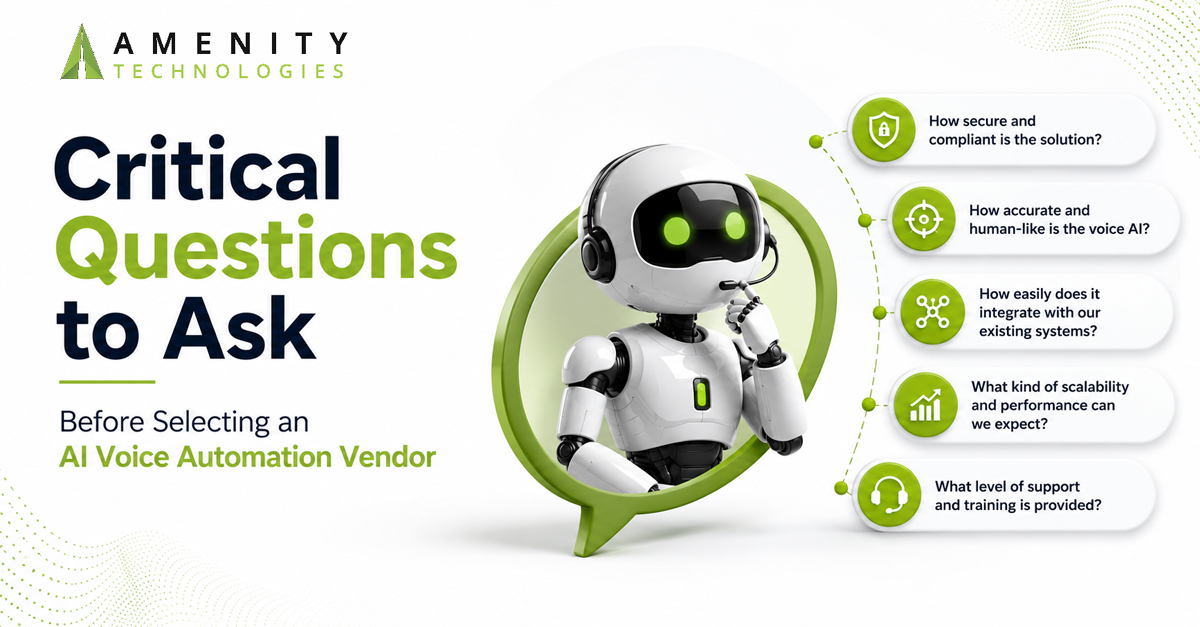
Selecting an AI voice automation vendor is a high-stakes architectural decision.
Voice AI now serves as your primary customer interface. It’s integrated into the systems to answer calls, book appointments, resolve requests, and collect data before a human agent ever joins the conversation. If it performs poorly, customers feel it immediately.
The challenge is that most Voice AI vendors look impressive during early conversations. Demos are smooth. Conversations sound natural. Case studies highlight the best scenarios.
The real difference appears after deployment.
That is why vendor selection requires structure. If you ask the right questions early, you protect your budget, your customer experience, and your long-term flexibility.
This post explores some of the critical questions that you should have before choosing an AI voice bot vendor in 2026.
Checklist: Key Questions to Ask Voice AI Vendors
Q.1. What Problem Is This Voice AI Actually Solving?
Before evaluating vendors, first you need to clarify your own business objective behind investing in Voice AI solutions.
Are you trying to reduce call wait times? Handle after-hours call volume? Replace repetitive booking calls? Improve routing accuracy? Lower staffing pressure?
If your internal goal is unclear, vendors will focus on their strengths rather than your actual requirements.
A trustworthy AI voice bot vendor will ask about your operational bottlenecks before talking about AI features. If the conversation begins with model specifications instead of business challenges, this is your chance to pause and think twice before you partner with the vendor. Technology should follow purpose.
Q.2. How Scalable Is the Voice AI Infrastructure?
Elasticity is not merely the ability to handle a significant volume of calls. It is about handling them consistently in the long-run.
Prepare your questions for the vendor. You can ask:
– How many concurrent calls can the system manage?
– What happens during seasonal spikes?
– Does performance degrade under load?
– Is infrastructure cloud-based, on-premise, or hybrid?
In the current landscape, enterprises cannot afford voice systems that collapse during peak demand. A reliable Voice AI platform should demonstrate stable performance under pressure, not just in controlled demos.
Request real throughput numbers, not theoretical capacity.
In 2026, performance is not measured only by volume handling but also by latency. Ask about turn-taking latency. Can the service provider actually guarantee response times under 600 milliseconds? Delays beyond that threshold often result in “talk-over,” awkward pauses, and fragmented conversations. Real-time responsiveness is what separates a functional bot from a conversational system that feels natural.
Q.3. How Deep Is Backend Integration?
A voice bot without proper integration becomes little more than an advanced IVR machine, which may not justify the investment.
Demand clarity on the following technical requirements:
– Can the system access our CRM in real time?
– Can it update appointment schedules directly?
– Does it connect to billing, order management, or ticketing systems?
– Who manages API coordination?
The depth of integration determines automation value for the long-term. If the vendor avoids specifics or frames integration as “future scope,” that is a signal.
Voice automation solutions generate ROI when they execute tasks, not when they simply route calls.
Additionally, clarify how intent recognition works. Ensure the system uses Large Language Model-based intent extraction rather than simple keyword spotting. The bot should understand natural variations such as “I’m calling because my sink is leaking” just as effectively as “Emergency plumbing repair.” Relying on keyword triggers alone recreates legacy IVR behavior in a different format.
Q.4. How Is Human Escalation Managed?
It is not a smart decision for any business to opt for complete automation. Human involvement is critical at many points of the customer journey such as exception handling, dispute resolution, strategic conversations, compliance-related queries, and situations that require empathy or discretion.
Ask:
– What actually triggers call routing to a human agent?
– Is sentiment analysis feature used to detect frustration?
– Does the agent receive full conversation context?
– Can escalation rules be customized?
Poor escalation damages trust quickly. A mature AI voice bot vendor will describe Human-in-the-Loop logic in detail, not vaguely.
The purpose of automation should be to reduce friction, not to trap callers in loops.
Q.5. What Does the Total Cost Structure Look Like?
You can protect your long-term budget by gaining clarity on Voice AI solution pricing.
Rather than just asking about Voice AI development fees, you can request a breakdown of:
- Infrastructure costs
- Usage-based charges
- Maintenance and optimization fees
- Model retraining expenses
- Integration support
Some Voice AI vendors price aggressively upfront and recover margins through usage scaling. Others offer fixed structures with predictable growth costs. You need to distinguish them clearly. The comparison often reveals the real picture. Additionally, you can ask for a 12 to 24 month cost projection.
6. Who Owns the Data?
Voice bots are trained to collect all valuable conversation data. This data contains customer intent, preferences, and operational insight.
Ask directly:
– Who owns recorded conversations and transcripts?
– Can we export data anytime?
– What happens to our data if we terminate the contract?
– Will the model continue to perform well even when we switch vendors?
Vendor lock-in risk increases when ownership terms are unclear.
A responsible AI voice bot vendor answers these questions confidently and in writing.
7. How Is Compliance and Security Handled?
Voice AI systems will have access to sensitive business and customer related information such as payment data, account details, and regulated industry content.
So, when you are shortlisting Voice AI vendors by yourself, ask them:
– Where is data stored?
– How is it encrypted?
– Are recordings anonymized?
– Is the platform compliant with regional regulations?
Vague assurances are not enough. Compliance measures should be clearly documented and verifiable to make sure there’s no issue later.
In regulated markets like the US and EU, automatic PII redaction is critical. Ask whether the system removes sensitive information like Social Security numbers, credit card details, or personal identifiers before storing transcripts or using data for model refinement. Privacy protection should be engineered into the system, not handled manually.
8. What Happens After Launch?
Once the Voice AI system is deployed, it is not over. The system performance should be improving over time, this can be done through timely monitoring and effective refinement.
Ask the vendor about:
– Who reviews conversations that do not go as planned?
– How often is the system improved or updated?
– Is performance reporting part of the service?
– What metrics are used to measure success after launch?
In case some of the vendors in your shortlist treat launch as the final milestone, you should definitely think twice before choosing them.
A strong vendor views implementation as the beginning of a performance cycle.
9. Can You Share Real Performance Benchmarks?
Case studies are useful, but you should prioritize details as well.
You can request the vendor for:
- Average containment rates
- Booking throughput improvements
- Speed-to-answer metrics
- Typical time-to-value
There’s no instant results in AI deployment. Be cautious of vendors who promise immediate high automation without discussing learning curves.
Voice AI requires calibration. Overconfidence without detail often signals immaturity.
10. What Are the Exit Terms?
Few businesses ask about the exit terms when partnering with Voice AI service providers. You should consider yourself in those few.
You can ask about:
- Contract length
- Termination clauses
- Data export processes
- Transition support
Vendor relationships sometimes change. Flexibility should be defined before implementation begins. Strong vendors do not hesitate to discuss exit clarity.
Final Thoughts: Choose Structure Over Sales Pitch
Voice AI is becoming foundational infrastructure, not an experimental add-on.
The vendor you choose will influence call handling efficiency, staffing strategy, customer experience, and long-term automation maturity.
Ask uncomfortable questions early. The model costs realistically. Clarify ownership and scalability.
You should avoid rushing the decision because the demo seemed interesting.
Are you evaluating AI voice bot vendors and want a structured discussion grounded in operational realities? Amenity Technologies can help you with it. Our team focuses on transparent planning, realistic ROI modeling, and long-term performance management.
We believe that voice automation works best when it is built deliberately.
FAQs
Q.1. Should we go with a specialized Voice AI provider or choose a full AI agency?
A: The choice depends on the project scope. If voice automation is central to your operations, a specialized vendor may offer deeper telephony expertise. If it aligns within a broader automation roadmap, a full-service AI service provider will be a better option as they may offer better cross-system alignment.
Q.2. How do we compare vendors with different pricing models
A: You should estimate the total cost over 12 to 24 months. This should include infrastructure, usage, optimization, and integration fees. Normalize everything into one view before comparing. Avoid choosing solely based on pricing. Opt for the highest value.
Q.3. How do we evaluate Voice AI accuracy before signing a contract?A: You should request a pilot or controlled proof-of-concept using your real call data. Accuracy of the Voice AI should be evaluated against your real call data, not generic demo scripts. This will give you a better idea of how the system may work for you. You can ask for intent recognition benchmarks and misclassification rates in environments similar to yours.
