

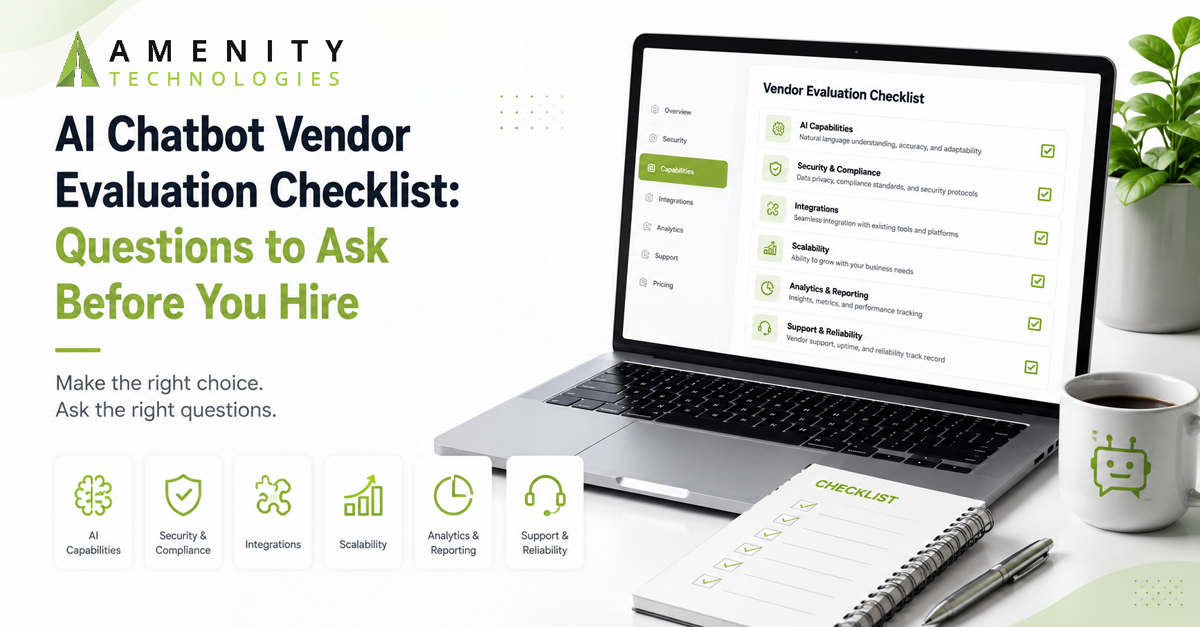
Choosing an AI chatbot vendor is a strategic capital allocation decision, not just a technical procurement.
Trusting the wrong AI partner can lock you into expensive contracts, underperforming systems, and constant revisions. The right partner can reduce operational pressure, improve customer response speed, and scale with your growth.
The challenge is that most vendors look impressive during sales conversations. Demos are polished. Case studies are selective. Promises sound confident. The difference only becomes clear after implementing these AI assistants.
That is why vendor selection deserves structure. If you ask the right questions early, you protect your investment before a contract is signed.
To avoid costly, long-term technical debt, we’ve created this helpful guide. It will walk through some questions that as a decision-maker you should ask before hiring an AI chatbot vendor.
Start With the Business Problem, Not the Technology
Before you move forward and start comparing vendors, you should clarify your own objective first.
– Are you trying to reduce support costs?
– Do you want to improve first response time?
– Is increased conversions your priority?
– Do you want to manage after-hours inquiries?
If your internal goal is vague, vendors will shape the narrative for you.
Ask yourself first: what operational bottlenecks are we going to solve by implementing an AI chatbot?
Once that is clear, the vendor discussion becomes focused.
You are evaluating alignment, instead of just AI features.
Now, let’s move to the set of questions to ask to AI assistant vendors before making a purchasing decision.
What You Must Ask AI Chatbot Vendor Before Investing in Their Services
Q. Does Your Domain Expertise Align With Our Regulatory Landscape?
Not all chatbot deployments are equal.
A vendor who has built bots for ecommerce may not understand healthcare compliance. A team that specializes in SaaS onboarding may struggle with complex financial workflows.
Therefore, you should ask some serious questions like:
Have you worked with other companies operating in our industry or in closely related sectors? If so, what challenges did you encounter the most? What would you do differently if we choose your services?
Audit provenance and experience. Listen to how they describe real implementation challenges. Well-known vendors speak about trade-offs and constraints, not just success stories.
Q. How Do You Define a Successful Implementation?
This question often reveals more than technical specifications.
Some vendors define success as system deployment. Others define it as performance metrics after launch.
Therefore, demand clarity on:
– What metrics will determine project success?
– What containment rate is realistic for our use case?
– How long does optimization typically take?
– If the answer sounds overly confident or immediate, pause.
After implementation, conversational AI solutions improve over time. Any AI vendor who promises instant high automation should explain how.
Q. What Does the Full Cost Structure Look Like?
This is where many businesses end up overspending. But, you should not repeat the mistake.
Don’t just ask about AI development fees. You need to ask for a complete breakdown that includes:
- Setup and design
- Integration costs
- Hosting or infrastructure
- API usage
- Ongoing maintenance
- Optimization support
Also it is critical to clarify contract terms. Is pricing fixed or usage-based? Are there penalties for scaling down? What happens if usage exceeds projections?
Ensuring financial transparency at this stage helps prevent post-deployment financial friction.
Q. Who Owns the Data and the Model?
Data ownership is often overlooked by most adopters. But you raise clear questions:
– Who owns the conversation data?
– Can we export it at any time?
– What is the model portability protocol if we transition vendors?
Your chatbot will collect confidential, valuable customer interaction data. That information should remain accessible to you even if a contingency events, such as contract termination, vendor disputes, or platform migration.
Vendor lock-in risk increases when these terms remain unclear.
Q. How Will the Chatbot Integrate With Our Existing Systems?
A chatbot without backend integration becomes a scripted FAQ tool. Ask:
– Can it connect to our CRM?
– Can it access order management systems?
– How complex are integrations?
– Who handles API coordination?
Integration depth directly impacts performance and ROI. Superficial integration limits automation capability.
If the vendor avoids detailed integration discussions, that is a warning sign.
Q. What Happens After Launch?
AI chatbot development is not the end. There are important responsibilities after implementation that you should understand in advance. Ask about ongoing monitoring, model retraining, performance reporting, and optimization cycles.
– Who reviews conversation failures?
– How often are improvements implemented?
– Is support included or billed separately?
AI systems require refinement. A vendor who takes no responsibility for anything that happens after launch leaves you with a static tool in a dynamic environment.
Q. How Do You Handle Escalation to Human Agents?
Full automation is rarely the goal. Smooth handover matters. Ask:
– How is context passed to agents?
– Can we customize escalation rules?
– Will customers need to repeat information?
Poor escalation design damages user experience faster than slow responses. A capable vendor should walk you through this process clearly.
Q. What Level of Customization Is Available?
You will encounter a few vendors who rely on rigid templates. Templates may reduce cost, but they limit flexibility. So, you should be clear about some things, including:
– Can conversation flows be customized fully?
– Can the tone align with our brand voice?
– Are we bound by predefined frameworks?
Your chatbot must reflect your business’s operational process and communication tone, not the vendor’s default design.
Q. What Security and Compliance Measures Are in Place?
Security conversations should not feel uncomfortable. If your business handles customer data, compliance is mandatory. Ask:
– How is data encrypted?
– Where is data stored?
– Are you compliant with relevant regulations?
– How do you handle sensitive information?
A trustworthy vendor answers confidently and specifically. Vague reassurances are not enough here.
Q. Can You Provide Real Performance Benchmarks?
Case studies are helpful. There’s no doubt about it. But real metrics are much better to understand what’s actually working for your operations.
So, ask for:
- Actual containment rates
- Average deployment timelines
- Typical optimization periods
- Measured cost reductions
Performance benchmarks show maturity. General statements show marketing.
Q. What Internal Resources Will We Need?
Vendors sometimes imply that implementation requires minimal involvement. That is rarely true. It will be helpful to inquire:
– How much time will our internal team need to commit?
– Who needs to be involved from our side?
– Will we need a dedicated chatbot manager?
Understanding internal effort protects your timeline and prevents unrealistic expectations.
Q. What Are the Exit Terms?
Only a few companies ask this question directly. You should not hold back. Ask questions like:
– How long is the contract term?
– What are termination conditions?
– Is there a data export process?
Vendor relationships sometimes change. So, it is better to have clarity upfront which can help maintain flexibility and smooth AI-driven conversations.
Warning Signs to Watch For
During discussions, pay attention to subtle signals. Be cautious if a vendor:
- Guarantees extremely high automation immediately
- Avoids discussing ongoing costs
- Downplays integration complexity
- Cannot explain optimization processes
- Provides vague answers about data ownership
Strong vendors acknowledge challenges openly. Overconfidence without specifics is rarely a good sign.
Final Thoughts
Selecting an AI chatbot vendor should feel deliberate, not rushed.
- Ask uncomfortable questions.
- Request detailed breakdowns.
- Model financial impact before signing.
- Clarify ownership and scalability.
The vendor you choose will influence customer experience, operational efficiency, and long-term automation success.
Technology evolves quickly. Vendor partnerships last longer. Protect your investment by choosing carefully.
If you’re searching for a reliable AI chatbot development partner that values transparency, structured planning, and long-term scalability, the team at Amenity Technologies is ready to support you. We have experience in crafting AI chatbots with clear scope, realistic ROI modeling, and operational accountability from day one.
Reach out to us and let’s design a system that performs beyond launch and delivers measurable value over time.
FAQs
Q.1. How many AI chatbot vendors should we evaluate before making a decision?
A: In most cases, three is a healthy number. One option gives you no comparison. Five usually creates confusion. When you speak with a few vendors side by side, patterns become obvious. You start noticing who focuses on outcomes and who focuses on features. Pricing structures also become easier to interpret once you have contrast.
Q.2. Should we choose a specialized chatbot company or a full-service AI agency?
A: There’s no universal answer. You can select based on your business’s internal needs. If you prioritize conversational performance and customer experience refinement, a specialized chatbot company will be a right partner. On the other hand, if the chatbot will sit inside a larger automation roadmap involving analytics, workflow redesign, and CRM systems, a full-service AI agency it is.
Q.3. How do we compare vendors fairly when pricing models are completely different?A: Ignore the headline price first. Take a look at what you will realistically spend over the next 12 to 24 months. Some vendors charge less upfront but increase costs through usage-based pricing. Others have higher setup fees but more predictable long-term costs. Now, put everything into one spreadsheet. Normalize it. Then compare.
