

The company in this case is a regional home services provider operating across two U.S. states. They handle HVAC installation, emergency plumbing, and electrical repair. Their business model depends heavily on inbound phone calls.
When something breaks at home, customers do not fill out forms. They just give a call.
By the beginning of 2025, call volume had grown steadily due to expanded service areas and aggressive local advertising. The company had 18 human support agents handling scheduling, quote inquiries, emergency routing, and general service questions.
Five of those agents were dedicated almost entirely to repetitive call types that were suitable for automation.
Over time, leadership began questioning whether that workload truly required five full-time staff members. They did not want to reduce service quality. They wanted to reduce inefficiency.
That is when they approached Amenity Technologies to evaluate Voice AI.
Let’s dive deep into this case study for clear insights.
The Unpleasant Situation: Identified Operational Inefficiency
Once we sat down with the operations team and listened to recorded calls, the pattern became obvious. Most of the day was not spent solving complex problems. It was spent confirming appointment windows, checking whether a technician was on the way, or answering pricing questions that had not changed in months.
The fact was that the agents were not underperforming; they were overloaded with repetitive interactions.
During busy periods, calls stacked up. A customer with a leaking pipe would wait behind three callers asking about service hours. That delay created stress internally and frustration externally.
Leadership did not want to cut corners. They wanted breathing room. But adding more agents would only increase payroll pressure without changing the structure of the workload.
The question shifted from “How do we hire more?” to “Why are human agents handling these simple things in the first place?”
Finding the Core Challenge: Look at the Call Data More Closely
We reviewed several weeks of inbound call recordings before recommending anything.
It was not enough to know that calls were repetitive. We needed to understand how people spoke, where conversations slowed down, and what moments required judgment.
What we found was actually simple. Most callers were trying to complete one specific task, such as booking a visit, confirming a time, or asking whether a warranty applied. In most cases, they were not looking for deep discussion. They just needed clarity with speed.
Agents followed nearly identical scripts for these situations. In some cases, the wording barely changed from one call to the next.
That consistency made the opportunity clear.
The Solution: Introducing Voice AI Carefully
There was hesitation at first. The leadership team did not want customers to feel they were trapped in an automated maze.
So we did not launch the system across all calls immediately. We initiated with a controlled rollout, only for appointment confirmations and rescheduling. These were low-risk, rules-based interactions. The kind that follows a clear sequence every time.
The Voice AI greeted callers in plain language. No robotic phrasing. No complicated menu trees. Just a straightforward question about what they needed.
If someone wanted to reschedule, the system accessed live availability and offered open slots. If the caller hesitated or asked something outside the defined flow, the call moved to a human agent with context attached.
We also built clear Human-in-the-Loop triggers into the system. Sentiment analysis monitored tone shifts in real time. If the Voice AI detected frustration, urgency, or specific emergency keywords such as “flooding” or “no heat,” the call was instantly warm-transferred to a senior dispatcher. The customer did not have to repeat details. Context traveled with the transfer.
The first few days were closely monitored. There were small adjustments, tone tweaks, and timing refinements. Slight changes in pacing made the conversation feel less mechanical. After that, this transition became noticeable.
What Changed Inside the Support Team
The most immediate effect of impact was not just fiscal; it was cultural.
Support agents reported fewer rushed calls. The pressure of watching the queue climb during peak hours started to ease.
Instead of repeating appointment schedules dozens of times per shift, agents handled exceptions, complex billing questions, and escalations that required empathy, which AI currently lacks.
The five agents whose workload had been mostly repetitive were not dismissed; they were re-skilled and reassigned. Two moved into outbound follow-ups. One focused on quality assurance. Two shifted toward upselling maintenance packages during live conversations.
The Voice AI did not replace people. It replaced repetition.
What Customers Experienced
From the customer’s perspective, the biggest difference after the AI implementation was speed.
Calls were answered immediately, even outside normal staffing windows. Appointment adjustments could be completed without waiting on hold.
There were concerns that callers might resist automation. That did not happen.
Most people did not comment on the technology. They commented on the lack of waiting. Customer reviews began mentioning responsiveness rather than delays.
Additionally, consistency improved. Pricing explanations and policy-related information were delivered the same way every time. No variation based on who happened to answer the phone.
Booking Throughput During Peak Hours
Morning rush periods used to overwhelm the support desk. Five agents could only handle so many calls at once. The Agentic Voice AI changed that dynamic.
During peak windows, the system handled up to 50 concurrent calls while maintaining consistent booking logic. That shift improved booking throughput by roughly 40 percent compared to the previous staffing ceiling. Volume no longer created bottlenecks.
The Operational Shift
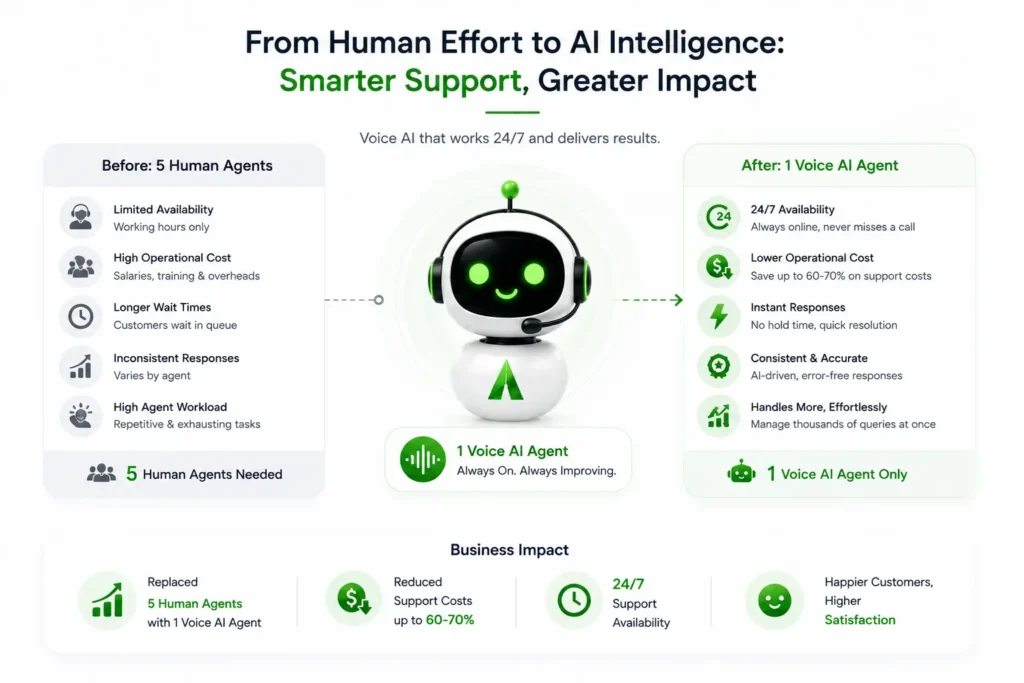
Within a few months, the company realized that the workload equivalent of five full-time agents had been absorbed by the Voice AI system. It did not just automate the process; it transformed it.
This shift did not take place overnight. It happened gradually, as more routine call types were added into automation after testing.
There was no spike in complaints. No measurable drop in satisfaction. No confusion about escalation paths. Instead, the company found itself operating with more flexibility.
When seasonal demand increased, they did not need to scramble for temporary hires. The Voice AI handled volume fluctuations without fatigue.
That stability mattered more than the raw cost savings.
Financial Impact Without Dramatics
Yes, the financial benefit was real. Reducing dependency on five routine-call positions translated into significant annual savings when considering fully burdened labor costs and turnover.
But leadership viewed the savings as secondary. The real win was predictability.
They were no longer tied to staffing ratios for repetitive tasks. Growth in call volume no longer automatically meant growth in payroll. The cost structure became more stable.
Leadership described the shift as gaining Labor Elasticity. When extreme situations increased call volume, the system absorbed the surge without emergency hiring. During slower periods, staffing levels remained stable. The company was no longer tied to seasonal payroll swings just to handle repetitive volume.
What This Project Reinforced
Prioritizing voice automation is not about replacing the entire human support teams. It works best when one utilizes it accurately.
Some conversations require empathy. Others require accuracy.
Routine scheduling and confirmation calls require accuracy.
By separating the two, the company improved both types of conversations.
For the company, human agents now handle conversations that benefit from nuance. The Voice AI handles the predictable ones without inconsistency.
That separation created balance.
This is something that every business should keep in mind before automating everything.
Operational Impact (Year 1)
- Headcount Realignment: 5 agents reassigned to upselling and quality assurance roles
- Average Speed to Answer: Reduced from approximately 4 minutes to under 2 seconds
- After-Hours Booking Rate: Increased by 55 percent
- Script Consistency: 100 percent compliance with pricing and legal disclosures
Build a Voice AI System with Amenity Technologies
If your organization depends on inbound phone volume but struggles with repetitive call load, Voice AI can create room without compromising service quality.
Amenity Technologies designs AI-driven voice systems that easily integrate into your existing workflows and reduce repetitive workload safely and deliberately. Our AI development approach focuses on structured call flows, clear escalation logic, and measurable performance benchmarks from the beginning.
We prioritize operational stability, ensuring automation supports your team rather than replacing critical human judgment.
Talk to our team to explore how Voice AI can support your operations without increasing headcount.
