



AI system implementations often begin with pilots. It is an easy way to start. However, as we move ahead to production systems, things become challenging.
Many organizations launch proof of concept projects with enthusiasm. Models are tested. Demos look promising. Internal presentations generate optimism. Then momentum slows, and technical gaps surface. Integration becomes complex. Governance concerns rise. The pilot remains a pilot.
This case study is about an insurance company that did not stop at experimentation.
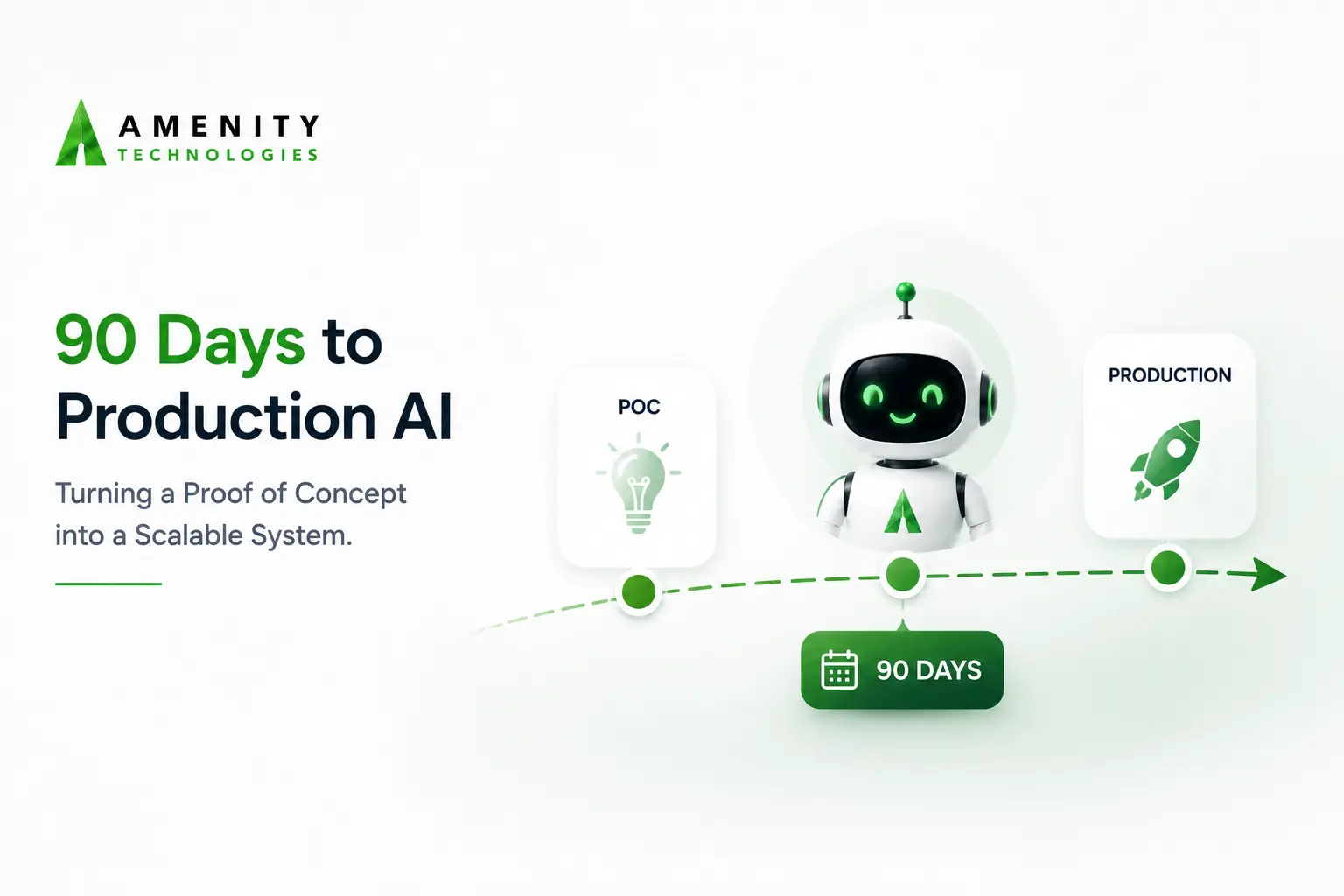
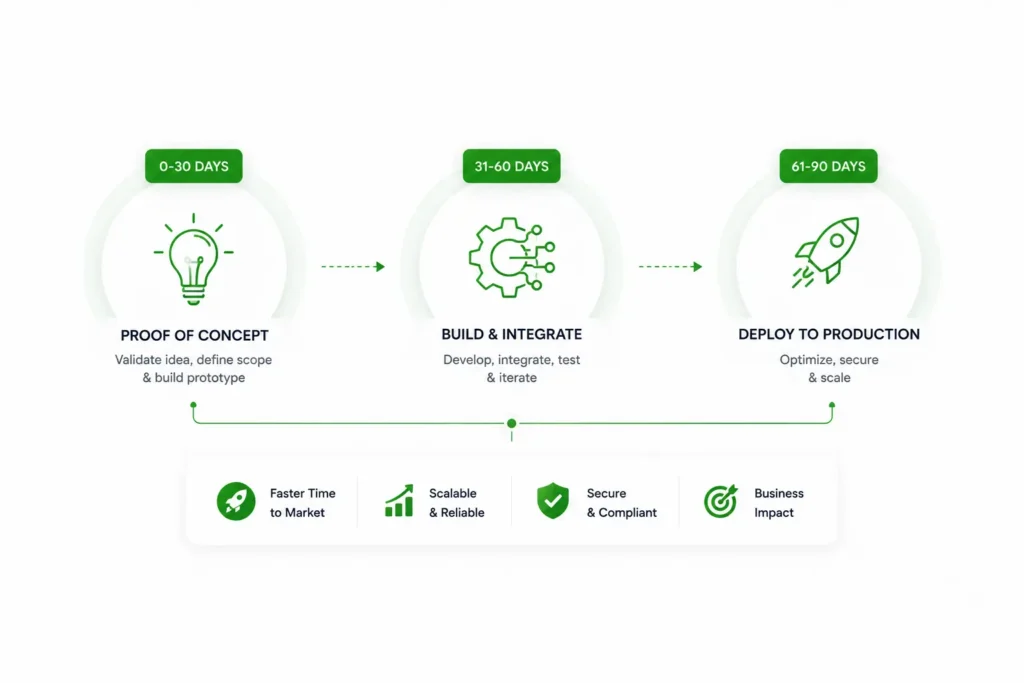
In ninety days, they transitioned from a small AI proof of concept (POC) to a fully integrated production system that now operates inside their core workflows. The deployment was structured, measured, and aligned with real operational needs from day one.
The Challenge: Bridging the “Last Mile” to Production
The organization operated in a regulated environment with high operational volume. Their internal teams manually triaged thousands of incoming insurance claims each week. They were all overburdened because of categorizing claims, assessing risk, and routing claims to the appropriate review teams. The workload was predictable, yet time consuming.
A data science team had built a claims classification and risk scoring model trained on historical claims data. Accuracy was promising, and early validation suggested meaningful time savings. The AI acted as a decision-support tool, not an autonomous approver.
But there was a big problem.
The model existed in isolation. It lacked connections with other live systems. It required manual input. There were no monitoring controls, no escalation logic, and no structured oversight. And most importantly, compliance review had not yet been addressed.
While the POC was technically sound, it lacked production readiness.
Leadership faced a familiar question. Do we invest in turning this into a scalable system, or do we treat it as a useful experiment?
They chose to move forward, but with discipline in mind.
The Core Challenge: Bridging the Gap Between Model and Operations
The gap between proof of concept and production was not about model accuracy. It was about operational alignment.
Many issues arose that required resolution:
- Integration with existing systems
- Security and access controls
- Clear human override mechanisms
- Monitoring and performance logging
- Governance documentation
The actual model could classify inputs correctly. But production required more than just accuracy. There was a need for reliability under real-world conditions.
The company actually needed a structured path to deployment. Not another round of experimentation.
The Solution: Structured Deployment Instead of Rebuilding
Instead of redesigning the AI model completely, they prioritized building the surrounding operational architecture.
The first decision was quite simple. Build the operational layer around the model before expanding its intelligence.
The AI claims classification engine would be embedded directly into the claims intake workflow rather than replacing it. Clear decision thresholds were established. If the AI confidence score dropped below an agreed level, the case would automatically route to a human reviewer.
The model analyzed structured claim attributes along with historical patterns to generate a probability-based risk score for each submission.
There was no attempt to eliminate human involvement entirely. The goal was to reduce repetitive workload while preserving oversight.
This mindset shaped the entire AI system deployment process.
The 90-Day Production Roadmap
The company did not treat deployment as a “go-live” event. It treated it as a controlled transition.
There was no dramatic switch from manual to automated. Instead, the first few weeks were spent understanding where the model could safely exist inside the claims workflow.
Weeks 1–3: Defining Boundaries
Before integration began, the team revisited the claims lifecycle in practical terms.
– Where does a claim enter the system?
– Who touches it first?
– Where are compliance checkpoints triggered?
– At what stage does professional judgment become critical?
These conversations were not theoretical. Claims supervisors and compliance officers were in the room.
By the end of this phase, the AI had a defined boundary. It would support early-stage triage; not final approval decisions. That clarity prevented scope creep later.
Weeks 4–8: Quiet Integration
The integration itself was technically straightforward, but operationally sensitive.
The model was connected to the existing claims platform. Risk scoring was triggered automatically upon intake. Manual uploads disappeared.
A more subtle change was the introduction of decision thresholds. Claims above a predefined confidence level moved through standard routing, while those below it automatically triggered a Human-in-the-Loop (HITL) review.
Nothing was hidden. Every automated classification was logged. Every override was recorded. Model versions were documented. Compliance had visibility from day one.
This wasn’t automation replacing people. It was structured assistance.
Weeks 9–12: Limited Rollout, Close Observation
The first deployment covered only lower-complexity claim types. No one wanted surprises in high-risk categories.
Performance was reviewed daily at first. Not through dashboards alone, but through case reviews.
– Were borderline claims being routed correctly?
– Were certain patterns slipping through?
– Was the workload actually shifting?
Thresholds were adjusted carefully. In some cases, they were tightened rather than relaxed.
By the end of the ninety-day window, the system had proven stable enough to expand into additional claim segments.
It was no longer described internally as “the pilot.” It was simply part of intake.
Operational Reality Check
Claims specialists remained accountable for complex evaluations and edge cases. The AI system handled predictable intake patterns, filtered volume, and surfaced anomalies. Final authority never left the review team.
This distinction was deliberate. The objective was not to replace professional judgment. It was to remove repetitive sorting so expertise could be applied where it mattered most.
That clarity prevented resistance and ensured the system was adopted as support, not disruption.
Results: Measured Gains, Not Marketing Numbers
Within weeks of AI model deployment, repetitive triage work began to decline. Routine claims moved through intake with fewer manual touchpoints. Reviewers spent more time on complex evaluations instead of sorting predictable, repetitive cases.
Processing timelines improved in lower-risk categories where confidence scores remained stable. Early-stage inconsistencies narrowed. Decisions became more uniform without removing professional judgment. Audit reviews also became simpler. Every automated action was logged, traceable, and explainable.
There was no operational disruption during rollout. No sudden dependency on automation. Just a quieter, more consistent intake process that reduced friction without increasing risk.
What Actually Enabled the Shift
It wasn’t model accuracy. The original proof of concept had already demonstrated reasonable performance.
What made the difference was restraint.
The company did not rush to expand functionality. It did not attempt full automation. It built guardrails first, then integration, then scale. That sequence mattered.
By treating production as an operational design problem, not a data science challenge. They avoided the stall point that traps many AI initiatives.
Ninety days was enough for the organization.
Not because the model was extraordinary. But because the deployment was disciplined.
When a Pilot Should Move to Production
Many AI initiatives stall after the proof-of-concept phase. And most of the time, the reason isn’t the model failure. It is because production planning never begins.
This case shows that the transition does not require reinvention. It requires structure, boundaries, and disciplined execution.
If your organization has a working AI pilot that remains disconnected from core systems, the next step may not be more testing. It may be controlled deployment.
Amenity Technologies helps regulated enterprises move from isolated models to governed production systems without disrupting existing operations.
Sometimes progress is not about building more. It is about finishing what you already started.
If you are evaluating how to move your AI pilot into production, our team can help you design the transition deliberately and responsibly. We’ll be more than happy to begin a long-term partnership with you and optimize your operational workflows.