
 ALL ARTICLES
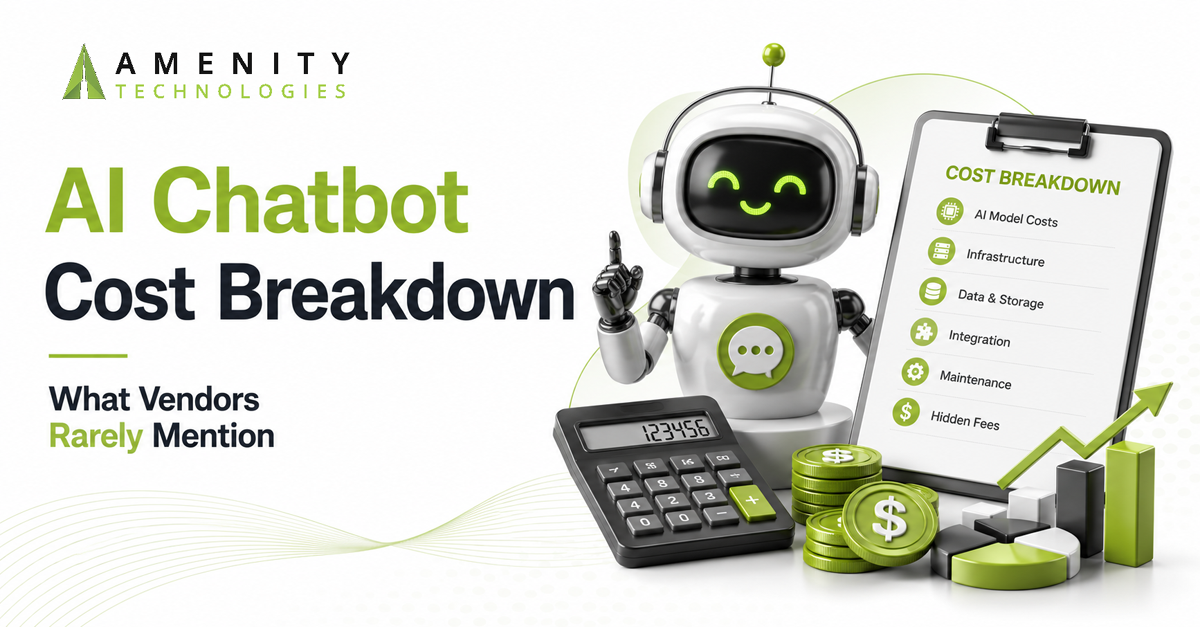



AI solutions vendors often market their AI chatbots to be drivers of operational efficiency.
They claim their AI tools can:
– Reduce support workload.
– Automate repetitive queries.
– Be available 24/7.
The pitch is compelling. The demo looks impressive. The pricing sheet appears manageable.
But what many organizations discover after signing the contract is this: the initial quote rarely reflects the full operational cost of running an AI chatbot in production.
The hidden expenses are not always intentional. Sometimes they’re just overlooked. Sometimes they’re buried inside customization or advanced configuration. And sometimes, they simply appear as your chatbot starts interacting with real users.
If you are evaluating AI assistant vendors, it’s important to understand where costs quietly accumulate. So, let’s go through this topic in detail.
Hidden Costs Missing from Vendor Quotes
Integration Is Not a One-Time Event
Most vendor quotes focus on AI chatbot development itself. Few emphasize what it takes to integrate that tool into your actual business systems.
An AI assistant that only answers FAQs involves less cost. Conversely, a smart digital assistant that is integrated with your CRM, ticketing system, payment gateway, inventory database, or claims platform is an entirely different investment because:
– API integration takes engineering time.
– Data mapping requires testing.
– Security reviews slow deployment process.
In regulated industries, integration also demands compliance approval. Logging standards need to be clearly defined. All access permissions must be reviewed properly. Encryption policies must align with internal controls.
None of these costs are clearly outlined during the initial pricing discussion. And yet, integration often consumes more effort than AI model development.
Training Data Is Never “Done”
Many vendors usually tell the businesses that once the digital assistants are trained, they’re ready to go. However, in real use cases, the AI assistant performance depends on continuous refinement because:
– User queries change.
– Products evolve.
– Policies update.
– New edge cases appear.
All of these factors make it critical to have regular retraining or prompt refinement. Without it, performance level drops significantly. To avoid degradation, organizations must rely on ongoing:
- Dataset updates
- Intent retraining
- Response refinement
- Validation testing
- Quality assurance cycles
Some AI firms charge separately for “model optimization” while others bundle it into premium support tiers. Either way, maintenance is not optional. It is critical to operational success. And it has a cost.
Inference Costs Grow With Usage
One of the least discussed expenses is inference. Every time a user interacts with your chatbot, the model processes input and generates a response. That computer activity has its own expense.
At low traffic volumes, inference expenses are easily manageable. But as adoption increases, costs scale linearly or exponentially.
In high-frequency environments like e-commerce, banking, travel, and SaaS support, inference costs grow faster than projected.
What looked affordable at 5,000 conversations per month may look very different at 150,000.
If your vendor uses large language models for every request, that cost multiplies quickly. Therefore, inference economics cannot be ignored. Most quotes don’t break this expense down transparently, and this may lead to unexpected cost overruns once usage begins to scale.
Human Oversight Doesn’t Disappear
A common misconception is that AI conversational agents fully automate away the support team. In real use cases, it’s not true. They are just used to shift workload.
Complex cases still escalate. These require Human-in-the-Loop (HITL) to allow sensitive queries to be directly routed to professional support teams. Regulatory workflows still demand accountability.
In fact, during early deployment phases, human oversight often increases. Here, teams must keep tracking:
- Misclassifications
- Hallucinated responses
- Escalation accuracy
- Context retention issues
- Tone inconsistencies
Someone must be tasked with performance monitoring. Some should audit logs. Some must handle edge cases.
AI Chatbot Customer Service helps reduce repetitive effort. It does not remove responsibility. Most likely, that operational layer isn’t mentioned in the vendor proposals. As a result, it becomes another hidden cost organizations must account for.
Security and Compliance Add Hidden Layers
For organizations in finance, insurance, healthcare, or enterprise SaaS, compliance is not optional.
AI chatbots usually interact with customer data. And sometimes they are exposed to confidential information. That introduces additional requirements, including:
– Access control reviews
– Data residency alignment
– Logging retention policies
– Vendor risk assessments
– Model explainability documentation
Because of this, internal audit teams may need documentation before approving full deployment. Also, the legal teams must review vendor contracts for liability clauses.
These processes do not make the chatbot smarter. But they add time and cost. And they are often underestimated.
Customization Extends Beyond Tone and Branding
AI solution providers frequently promote “custom branding” as a simple configuration. But real customization usually goes deeper than what they claim to offer at first.
Businesses need chatbots to reflect:
- Internal terminology
- Industry-specific workflows
- Escalation hierarchies
- Compliance language
- Decision boundaries
Generic responses are usually insufficient. In many cases, companies require RAG Chatbot Development so the system can retrieve information from internal documents, knowledge bases, or operational data while generating accurate responses.
As customization expands, so does development effort. And unlike template-based deployments, custom architecture increases long-term maintenance responsibility. In short, the more tailored the solution, the more carefully it must be maintained.
Performance Monitoring Is an Ongoing Obligation
Once the chatbot is implemented and goes live, evaluation becomes critical.
You must constantly track:
- Containment rate
- Escalation percentage
- Average response latency
- User satisfaction scores
- Error frequency
If the chatbot underperforms, adjustments are non-negotiable.
Monitoring dashboards need to be built or integrated. Alerts must be configured. Performance thresholds need definition.
Some vendors offer analytics add-ons. Others leave monitoring to internal teams. Either way, performance management is not a one-time setup. It becomes part of your operational rhythm.
Scaling Multiplies Complexity
A chatbot launched for one department is manageable. But, when you plan on scaling that chatbot across regions, languages, or product lines introduces new variables.
– Multilingual support requires translation accuracy testing.
– Regional compliance rules differ.
– Customer expectations vary.
What worked in a limited rollout may need reconfiguration at scale.
The AI model must be able to manage traffic spikes in high-demand situations. To do this, caching strategies may be required. Model routing may need refinement to manage inference costs efficiently.
Scaling the chatbot doesn’t mean that the cost will be doubled. It usually compounds it.
Vendor Lock-In Is a Strategic Cost
One hidden factor many teams often overlook is flexibility. Some AI firms depend on proprietary frameworks. Migrating away later becomes challenging.
If your chatbot logic, data mappings, and integrations are tightly coupled to one provider’s ecosystem, switching vendors is highly likely to become expensive.
This is not a line-item cost on an invoice. It is a strategic constraint.
Understanding portability, API ownership, and model independence early can prevent long-term financial friction.
The Real Cost Is Operational Ownership
Perhaps one of the most overlooked expenses of AI chatbots is internal ownership.
Someone in your organization must:
- Define chatbot objectives
- Approve updates
- Keep track of performance
- Coordinate vendor communication
- Align chatbot behavior with business changes
Without clear ownership, AI assistant quality deteriorates over time. That role is usually not accounted for in ROI projections.
Remember that AI chatbots are not static tools. They are operational systems. And operational systems require governance.
Ending Note
The hidden costs of AI chatbots are not necessarily deceptive. They are usually structural. Integration, inference, compliance, customization, monitoring, and scaling all contribute to total cost of ownership. And this is often not included in the vendor’s quote.
The quote you receive may cover deployment. It rarely covers the lifecycle. Understanding that difference before you sign is not skepticism. It is due diligence.
AI assistants can absolutely transform customer communication and internal workflows. But like any production system, they need clarity, planning, and operational commitment.
Knowing the full picture can be the first step toward making them truly cost-effective.
If you’re planning to deploy an AI assistant and want transparent cost modeling beyond the initial quote, the team at Amenity Technologies can help you out. We work closely with enterprises to map integration, inference, and lifecycle planning from day one, helping reduce unexpected cost surprises.
FAQs
Q.1. How can we estimate the total cost of ownership (TCO) of an AI assistant before deployment?
A: Achieve TCO clarity by modeling expected conversation volume, required system integrations, compliance overhead, and post-launch optimization cycles. Requesting a usage-focused pricing breakdown can help prevent budget surprises later.
Q.2. What are the risks of deploying an AI chatbot without a clear escalation strategy?
A: If you don’t have defined escalation pathways, it is possible that you may receive inaccurate or incomplete responses for complex issues. This can damage trust level and increase support friction. A clear routing and human handoff framework ensures that automation enhances the experience rather than damaging it.
Q.3. Can AI assistant costs be optimized after deployment?A: Yes. Techniques like request routing, caching, using smaller models for predictable queries, and refining prompts can significantly reduce inference and infrastructure costs. Ongoing optimization is often the clear difference between sustainable scaling and escalating expenses.