
 ALL ARTICLES
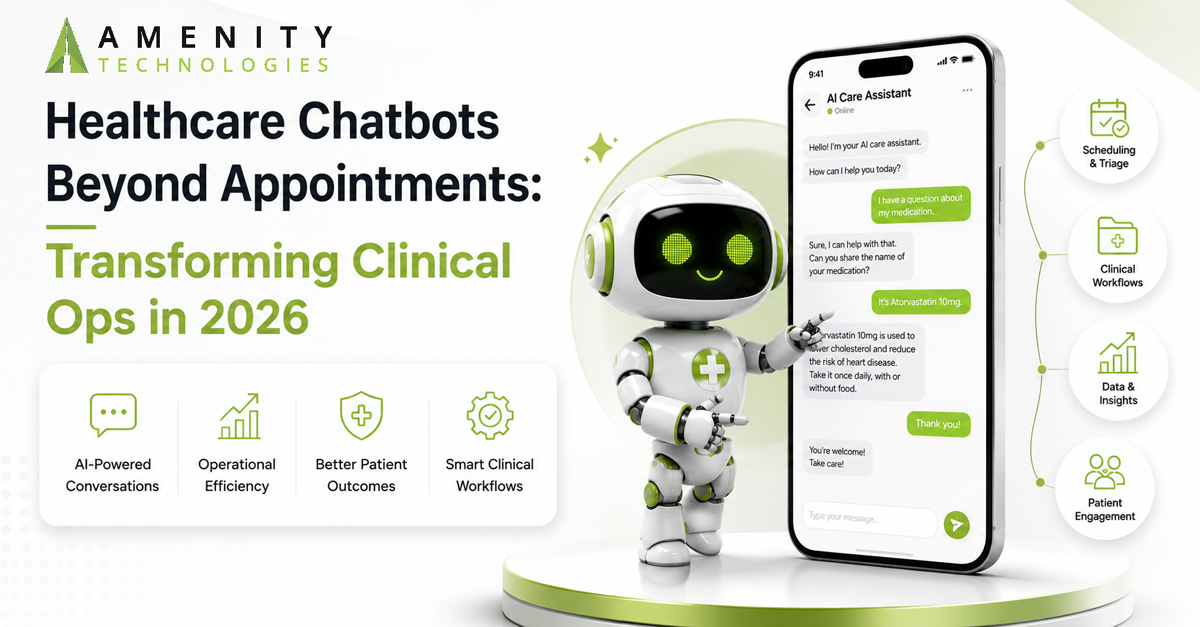



For years, healthcare chatbots were limited to appointment booking, reminders, and FAQs. Useful; but not operationally transformative.
In 2026, hospitals are deploying healthcare chatbots for clinical operations; not just front-desk automation. They now support nurse triage intake, discharge communication, internal coordination, and administrative workflows.
This shift didn’t happen because chatbots suddenly became smarter. It happened because hospitals ran out of bandwidth. Staffing shortages, rising patient volumes, and documentation burden forced clinical operations teams to look for structured automation.
The question is no longer “Can a chatbot schedule?”
It’s “Where can conversational AI remove friction from clinical operations without introducing any unnecessary risk?”
In this post, we’ll walk through where healthcare chatbots are actually creating operational impact today!
The Real Challenge in Clinical Operations
If you interact with a nurse manager or a Clinical Operations Lead about what they struggle with the most, the complaints aren’t dramatic. They’re usually repetitive.
They usually say:
– “We spend too much time answering the same patient questions.”
– “Discharge instructions get misunderstood.”
– “Internal communication delays slow everything down.”
– “Triage lines are overloaded.”
You can notice that none of these challenges are related to medical expertise. They’re just about workflow friction.
And, in the healthcare sector, this friction costs more than just time. It affects patient experience, staff burnout, and sometimes clinical outcomes. So, this is not something one should ignore.
That’s where healthcare chatbots in 2026 are focusing; not on replacing clinicians, but on streamlining the healthcare operational edges around them.
How Healthcare Chatbots Support Clinical Operations in 2026
The real shift isn’t about smarter AI. It’s about operational pressure.
Hospitals are operating in a different reality now, staffing shortages, higher patient expectations, tighter margins, and constant documentation requirements. Clinical operations teams aren’t looking for “digital innovation.” They’re looking for breathing room.
Healthcare conversational AI assistants are being positioned exactly there, in the gaps where friction accumulates.
1. Nurse Triage Intake Support (Not Diagnosis)
Even with the implementation of advanced AI chatbots, nurse triage continues to be a Human-in-the-Loop (HITL) process.
Human involvement can’t be replaced because AI lacks the capability to fully understand context, empathize with patients, and assume legal accountability for critical, sometimes life-threatening, decisions.
What today’s nurse triage chatbots handle is structured intake before a nurse steps in. Patients describe symptoms conversationally. The chatbot organizes responses using approved triage protocols and flags urgency indicators.
By the time a nurse reviews the case, the repetitive questioning is already done. This saves time and energy spent in redundant tasks, allowing them to focus deeply on Top-of-License. Remember, it doesn’t replace expertise. It protects it.
At Amenity Technologies, we’ve seen triage automation become more powerful when conversational AI is paired with computer vision and IoT inputs. In some deployments, AI can monitor visible stress indicators or integrate with vital-sign monitoring systems before a nurse reviews the case.
2. Discharge Communication Automation
The discharge transition is one of the most critical operational moments in healthcare. They leave with paperwork, medication changes, and follow-up instructions. Often, many of them don’t fully absorb everything. That’s where they need assistance, and clinical ops automation act as a continuous digital care companion.
Patients can clarify instructions days later by accessing the chatbot, eliminating the need to call the hospital repeatedly. The chatbot references official discharge documentation and hospital-approved guidelines.
The result of this is fewer confused follow-up calls, better adherence, and lower readmission risk. This streamlines overall discharge and follow-up support.
3. Internal Coordination & Clinical Ops Automation
Clinical operations rarely fail because of major breakdowns. They slow down because of small, routine delays such as room status updates, policy clarification, bed availability checks, etc.
Internal chatbots connected to operational systems allow staff to retrieve this information conversationally instead of navigating multiple dashboards or calling departments.
Small time savings compound fast in hospital environments.
4. Administrative Workflow Automation
Pre-procedure reminders. Lab preparation instructions. Insurance document nudges.
Although these tasks are critical, they consume a significant clinical bandwidth, affecting workflows.
Smart AI assistants now handle these repetitive, time-consuming communications consistently. This ensures patients get the right information at the right stage of their care journey.
In many hospitals, one of the first measurable wins comes from discharge communication automation or intake form structuring. These touchpoints generate the highest repetitive load; and freeing that time delivers immediate relief to clinical staff.
It not only saves clinicians’ time and energy, but allows them to focus on care delivery, not logistical clarification.
5. Continuous Patient Engagement (Not Just Reminders)
From earlier traditional AI assistants, today’s clinical ops automation differ because they have a proactive engagement feature.
Instead of waiting for patients to call, chatbots trained to ask some critical questions such as:
“Have you reviewed your lab results?”
“Are you experiencing any new symptoms?”
“Do you need help scheduling follow-up?”
Yes, these aren’t marketing messages. They’re workflow-triggered interventions designed to prevent operational backlogs.
Areas Where Healthcare Chatbots are Still Struggling
Although the healthcare chatbots have upgraded impressively from traditional AI agents, they still have limitations that we can’t ignore.
The healthcare chatbots cannot interpret complex clinical nuances. They cannot diagnose ambiguous cases. They cannot override physician judgment. For these reasons, it becomes critical to involve specialized individuals (i.e., clinicians).
Modern hospital-grade chatbots rely on Retrieval-Augmented Generation (RAG) frameworks, meaning responses are pulled from approved clinical guidelines and hospital documentation — not generated from the open internet. This significantly reduces hallucination risk and maintains alignment with internal protocols.
Hospitals that succeed define clear boundaries early.
Chatbots support structure. Clinicians provide expertise. That distinction protects both safety and trust. If you keep this in mind, it will be easier to streamline workflows.
Why 2026 Feels Like an Operational Turning Point
Today, there are two things that have changed.
First, staffing shortages are no longer temporary disruptions. They’re systemic realities that need to be addressed effectively.
Second, conversational AI models matured enough to handle structured healthcare interactions reliably without sounding robotic or rigid.
Hospitals are no longer experimenting with AI assistants as digital front desks. They’re embedding them into clinical operations because operational sustainability demands it.
For years, we’ve been building the core building blocks behind this shift: NLP-driven assistants, computer vision modules, IoT integrations, and medical transcription automation. What feels like a 2026 breakthrough is actually the result of layered AI systems maturing inside healthcare environments.
Strategic Implications for Hospital Leadership
For years, healthcare chatbots were evaluated based on surface-level efficiency, including top-of-funnel metrics such as appointment volume, how many FAQs they could answer, and how much front-desk workload they could reduce.
But now, the hospital environments have drastically changed because of the upgraded chatbots. Also, leadership teams now look beyond convenience and ask deeper operational questions tied to workflow efficiency, risk control, and clinical impact.
The question is no longer whether chatbots can schedule patient appointments.
The real concern is:
– Where can conversational workflows remove friction from clinical operations without introducing risk?
The strongest use cases right now focus on:
- Triage intake support
- Discharge clarity
- Internal coordination
- Administrative automation
These are not some flashy innovations. They’re just operational resilience.
Closing Perspective
In 2026, healthcare chatbots are not being implemented to replace people. They are preserving human bandwidth in environments where it is increasingly scarce.
When deployed thoughtfully, they don’t feel like technology. They feel like smoother days, fewer interruptions, and clearer communication. And in clinical operations, that kind of quiet improvement matters more than headlines.
Most hospitals don’t need chatbots everywhere. They need them in the right operational pressure points.
Amenity Technologies assists healthcare organizations map clinical workflows and deploy conversational AI tools where they measurably reduce friction; without compromising safety or clinical authority.
Talk to our team about designing healthcare chatbots for clinical operations automation.
FAQs
Q.1. Are healthcare chatbots compliant with HIPAA and other healthcare regulations?
A: They can be, but only if they’re built properly. Compliance depends on encryption standards, secure hosting environments, access control policies, and data storage practices. That’s why, healthcare organizations are advised to ensure their chatbot provider follows strict healthcare-grade security protocols and regulatory compliance requirements from the start.
Q.2. How long does it take to implement a chatbot for clinical operations?
A: Implementation timelines vary based on complexity. A scheduling chatbot can be deployed quickly, but triage support or discharge automation needs internal workflow integration and clinical team validation. Hospitals usually move through pilot phases before full deployment to ensure safety and accuracy.
Q.3. Can healthcare chatbots scale across multiple hospital locations?
A: Yes, healthcare chatbots can scale across different hospital locations when built with centralized governance. Policies, triage pathways, and discharge templates can be standardized across locations while still allowing site-specific adjustments. Scalability depends more on workflow alignment than on the technology you’re utilizing.
Q.4: How do you ensure the AI doesn’t ‘hallucinate’ medical advice?A: We use the RAG (Retrieval-Augmented Generation) framework. This ensures the AI only pulls information from your hospital’s approved clinical guidelines and peer-reviewed sources, rather than the general internet.