
 ALL ARTICLES



It is quite easy to launch chatbots for your business communication needs. However, measuring whether they are actually worth the investment is where the majority of businesses struggle.
Many organizations measure chatbot success based on surface-level numbers, increase in message volumes, improved conversation count, or automation rate. While these metrics may appear encouraging at first in dashboards, they don’t answer the question leadership really expects: Is the chatbot delivering measurable business impact relative to its total cost?
Chatbot ROI calculation is not just a financial exercise. It is a strategic process that helps businesses understand whether an conversational AI assistant is reducing support costs, saving employee time, improving conversions, or generating revenue, instead of simply existing.
In this guide, we break down the calculation of AI chatbot ROI enterprise in a practical, outcome-driven way, focusing on real business impact rather than vanity metrics.
Why Chatbot ROI Is Often Misunderstood
Chatbots sit between technology, operations, and customer experience. Because of this, ROI is rarely measured accurately.
Common mistakes that businesses usually make include measuring activity instead of impact, ignoring indirect cost savings, treating ROI as a one-time calculation, and focusing only on cost reduction rather than overall business value creation. These mistakes may not be visible immediately but compound into significant inefficiencies over time.
A chatbot may answer thousands of questions and still underperform if it does not reduce agent workload, shorten response times, or influence revenue-related outcomes.
What Chatbot ROI Calculation Actually Means
Chatbot ROI calculation evaluates whether a chatbot delivers tangible value compared to the time, cost, and operational effort invested. It focuses on outcomes such as:
- Reduced support workload
- Faster response times
- Improved customer satisfaction
- Higher lead quality or conversion rates
Instead of asking, “is the chatbot actually functioning?” ROI calculation asks, “Is the chatbot improving business performance?” This shift ensures chatbot decisions are driven by data, not assumptions.
Steps for Effective Chatbot ROI Calculation
Step #1: Define the Business Goal Before the Formula
ROI calculation starts with clarity, not math. Before calculating ROI, define the primary business objective behind the chatbot. Begin by asking a few questions to yourself, including:
– Why was the chatbot introduced in the first place?
– What problem was it supposed to solve?
– Which team benefits the most from it?
For example, a customer support AI assistant may aim to reduce support tickets and save $20,000–$50,000 annually, while a sales AI assistant may focus on lead qualification and incremental revenue gains of $50,000+ per year. Without a clear goal, ROI calculations are meaningless.
Step #2: Understand the True Expense of a Chatbot
How much does it cost to build a chatbot? This is an important question that you should have. It has been seen in many businesses that the chatbot development process is implemented hastily without considering the actual chatbot development cost. This can be a significant contributor to lower ROI in the long-run. Therefore, you should not repeat the same mistake and focus on the chatbot development expense beforehand.
Direct Costs include chatbot design and development, AI or platform licensing fees, infrastructure or hosting costs, and ongoing maintenance and updates.
Typical cost drivers include:
- Initial development ranging from $15,000–$40,000
- Monthly running costs between $500–$3,000
- Cost spikes caused by LLM usage, multilingual support, complex integrations, or high traffic volumes
Indirect costs often overlooked include internal training, content updates, system integrations, and adoption efforts.
Step #3: Identify Clear ROI Metrics
Clear ROI and chatbot performance metrics are those that can be directly measured and linked to business outcomes.
1. Customer Support Cost Savings
If a chatbot is capable of resolving common queries, you should calculate the total number of tickets deflected, the average cost per human-handled ticket, and the reduction in support staffing needs. These chatbot evaluation metrics help you measure cost savings accurately over time.
2. Time Saved for Employees
Track time spent per task before and after chatbot adoption and multiply by the number of affected employees. Time saved doesn’t always show up on balance sheets, but it can directly affect overall productivity levels.
3. Revenue Impact and Conversions
Sales AI assistant impact ROI through improved lead qualification, reduced drop-offs, higher conversion rates, and increased order value. Even a 1–2% lift can drive substantial revenue at scale.
Step #4: Factor in Intangible (But Real) Benefits
Not all AI assistants value is immediately measurable. And ignoring these benefits undervalues ROI.
- Improved Customer Experience: It delivers faster, consistent, 24/7 responses, improving customer satisfaction and retention in long-run.
- Reduced Employee Burnout: It automates redundant queries, allowing support teams to focus on meaningful tasks. It lowers burnout and saves additional hiring expenses.
- Operational Consistency: Conversational AI tools deliver the same quality of response every time, reducing errors caused by manual handling.
Step #5: The Simple Chatbot ROI Formula (That Actually Works)
Once costs and benefits are clear to you and the AI assistant development team, ROI calculation becomes quite smooth. The formula for chatbot ROI calculation is as follows:
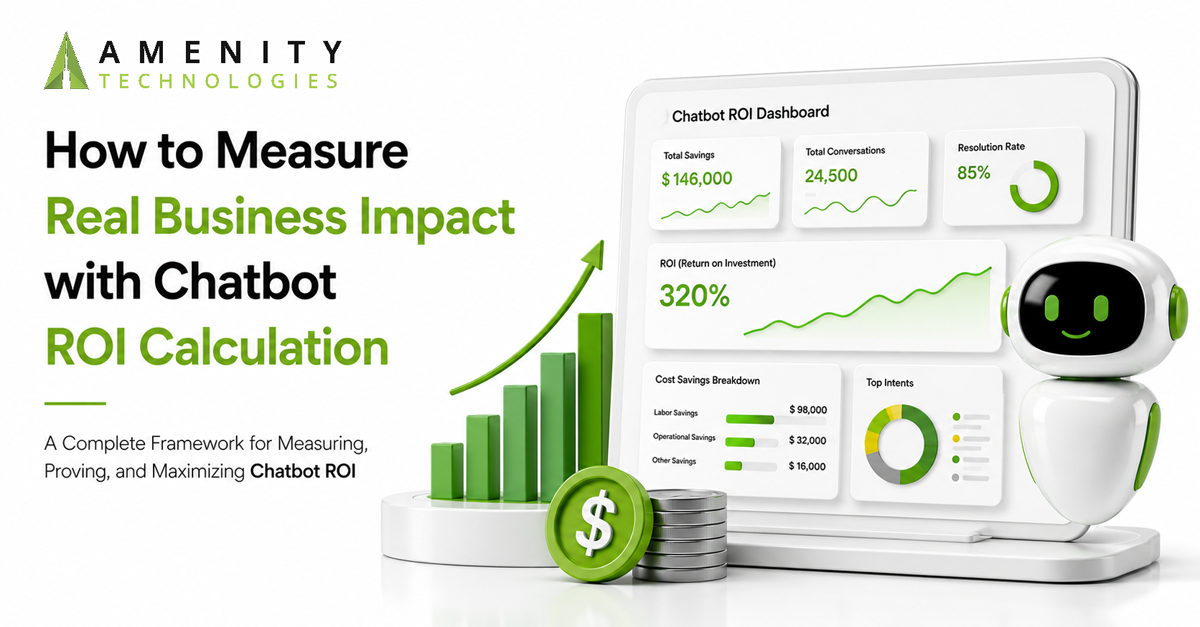
Chatbot ROI (%) = (Total Value Generated – Total Cost of Chatbot) / Total Cost of Chatbot × 100
* Worked Example on Customer Support Chatbot ROI
Scenario
– An ecommerce business receives 5,000 support tickets per month.
– Average human-handled ticket cost: $6.
– Annual support cost before chatbot: $360,000
Chatbot investment
– Development & setup: $25,000
– Annual maintenance: $10,000
– Total Year 1 cost: $35,000
Impact
– Chatbot deflects 40% of tickets (2,000/month).
Annual value generated
– 2,000 × $6 × 12 = $144,000
ROI calculation
– ($144,000 – $35,000) / $35,000 × 100 = 311%
Verdict
– In Year 1 alone, the chatbot paid for itself three times over, not counting the intangible benefits of 24/7 availability.
Real-World Scenario: The “Always-On” Lead Generator
(This scenario is based on Amenity Tech’s Case Study 08.)
The Challenge
A mid-sized tech firm was overwhelmed with missed opportunities. The key reason was their sales team being overloaded with constantly answering repetitive questions such as “What is your chatbot development service pricing?” or “Do you support X integration?”. Over time, they were having a lact of time and energy to focus on closing high-value deals. Potential clients often visited the site outside of business hours and left without engaging.
The Solution
The firm decided to shift to an AI-Powered Lead Generation Chatbot utilizing a Retrieval-Augmented Generation (RAG) pipeline. For this, they partnered with Amenity Technologies and enabled the specialized development team to build a solutions that understood company specific data and answer context-aware queries instantly.
The Result
Cost Efficiency: instead of hiring two junior sales associates to handle inbound queries, the bot handled the initial information gathering.
Revenue Impact
The bot operated 24/7, capturing leads that previously bounced during the night. By automating the follow-up and answering FAQs instantly, the human sales team only stepped in for “warm” leads who were ready to buy.
Outcome
The company saw quick response handling and enhanced customer experience. It proved that ROI isn’t just about saving money, it’s about improving revenue with steadily increasing conversions even when the support team isn’t available to serve prospective customers.
Final Thought: ROI Is About Impact, Not Impressions
A chatbot doesn’t create value just by existing, or by sounding intelligent. Any chatbot truly drives business value when it removes friction, saves time, reduces cost for the business, drives better decision-making, and improves experiences. Chatbot ROI calculation is a clear process that distinguishes “nice-to-have automation” from technology that genuinely moves the business forward.
If you’re investing in conversational AI, measuring ROI isn’t optional. It’s how you ensure the investment keeps paying off.
When you are ready with your clear objectives behind investing in conversational AI, you can reach out to Amenity Technologies. We offer custom-tailored AI-driven chatbot solutions that strengthen your communication.
FAQs
Q.1. Is Cost Reduction the Only Way to Measure ROI?
A: Not at all. Although cost saving is a significant element in measuring ROI, revenue growth and better user experiences are also critical to ensure optimal return on investment through the chatbot.
Q.2. Can chatbot ROI be negative initially?
A: Yes, when you implement chatbots into your systems, there may be negative ROI in the initial stage due to upfront cost and tuning requirements. However, the scenario can easily change over time as the bot becomes more precise, operational efficiencies improved, and measurable business value starts to outweigh the initial investment.
Q.3. How do we measure ROI for internal chatbots?
A: To measure return on investment for internal chatbots, you must prioritize total time saved, task completion speed and accuracy, as well as reduced internal support team workload. These factors can help you translate productivity gains into measurable business value.