

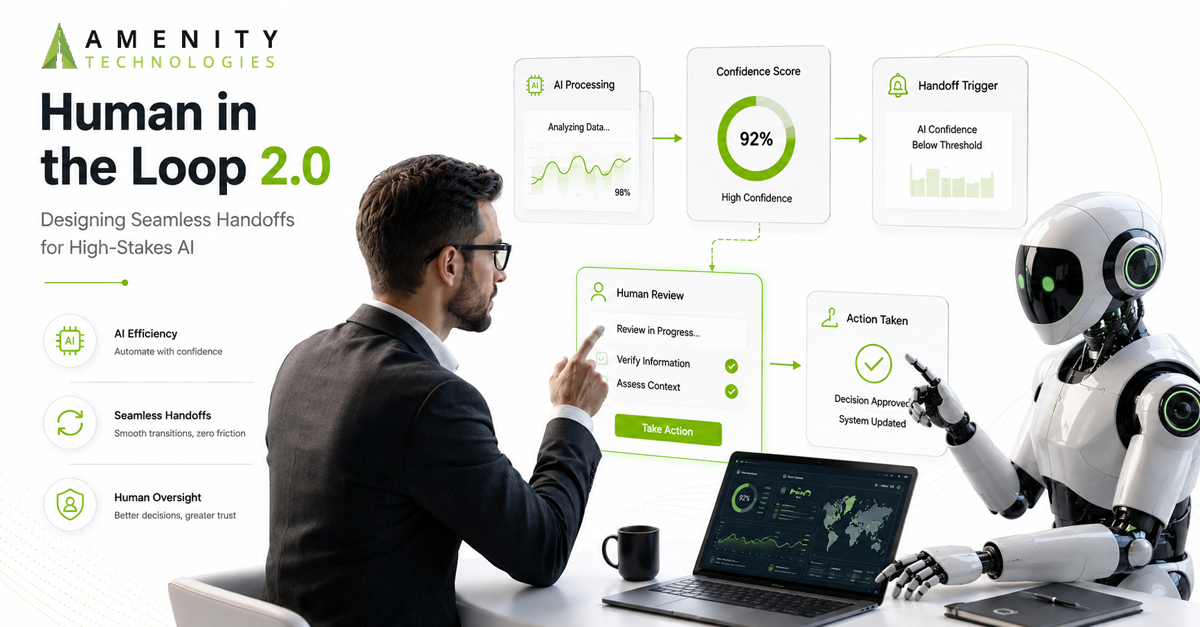
AI-driven systems are gaining a lot of attention these days, especially in making everyday business operations faster, smarter, and automated. There’s no doubt about the merits of growing AI involvement, but the risks of errors are also increasing. This is especially not acceptable in areas where wrong decisions may lead to significant consequences. In case of fraud detection, credit decisions, medical triages, safety alerts, and compliance checks, accuracy and accountability are more important than speed alone.
To eliminate the troubles, the process/approach of Human-in-the-Loop (HITL) 2.0 was introduced. HITL 2.0 doesn’t revolve around second-guessing every decision or slowing AI capabilities down. This advanced approach helps with designing clean, intentional handoffs between AI and humans. It helps each do what they’re best at. This effective balance mitigates the risk possibility of errors, strengthening trust and leading better results in high-stakes decision-making scenarios.
In this blog post, we will explain how HITL 2.0 enhances AI systems by creating smooth transitions between automation and human judgment, and why thoughtful handoffs, not brute control, are the key to safer, more reliable AI.
Why Traditional Human-in-the-Loop Models Fall Short
In the beginning, the conventional Human-in-the-Loop models were built on a simple idea of letting the AI solutions to the work first, then assign a skilled human to review the output. While it was a good way to begin, it often became time-consuming and error-prone. The most common issues included:
- Humans reviewing too many low-risk decisions
- Late interventions once the AI has already taken action
- Reviewers lacking context about why AI made a specific decision
- Fatigue from constant approvals, reducing attention where it mattered
These setups treated humans as backup safeguards instead of true decision partners. Over time, either the teams were over-trusting the AI systems or overrode the capabilities too often. These both situations undermined effective collaboration. HITL 2.0 addresses these gaps by redesigning when, why, and how humans step in to ensure seamless operations.
The Actual Purpose of Human-in-the-Loop 2.0
Human-in-the-Loop 2.0 is not about adding more checkpoints in between processes. It’s about smarter involvement of AI and human intelligence, forming a powerful hybrid . At its core, HITL 2.0 is built to focus on:
- Letting AI handle routine, low-risk decision-making autonomously (without requiring human assistance)
- Escalating only the right, significant cases to humans
- Giving humans clear context for the specific situations, not raw outputs
- Making handoffs feel natural, not disruptive to existing operations
Instead of humans supervising everything, they intervene where judgment, ethics, or accountability are non-negotiable.
The Importance of Seamless AI–Human Handoffs
A handoff is the point where responsibility moves from the machine to a human, or back again. When you fail to design handsoffs properly, they lead to unacceptable situations including confusions, errors, and delays. That’s why it is important to give proper time in ensuring a seamless AI-human handoffs process.
The efficient AI-human handoffs approach ensures that AI flags uncertainty instead of guessing, humans receive concise explanations, not overwhelming data, decisions resume smoothly after human input, and accountability is clear at every step.
In high-stakes environments, these transitions can decide whether the situation is controlled instantly or turns into a serious, costly failure.
Designing Better Handoffs: Key Principles of HITL 2.0 to Consider
1. Confidence-Based Escalation
Instead of following the traditional HITL approach with fixed rules, AI systems evaluate their own confidence in their own decisions. If the confidence level is low, they will quickly escalate to a human agent. On the other hand, if the confidence is high, the system will proceed automatically. This impressive advanced principle mitigates unnecessary interruptions while keeping critical decisions safe.
2. Context-Rich Explanations
Humans generally don’t rely on answers, they look for the reasons. HITL 2.0 ensures that AI clearly explains the primary reasons behind any decision-making, the alternative options that were considered, and where uncertainty remains. This context-driven explanation allows humans to make smart, fast, and better judgements.
3. Clear Ownership at Every Stage
Accountability is critical for AI-human involved decision-making. At any point, it’s completely clear who is responsible. HITL 2.0 clearly defines ownership. Whether the AI is acting automatically, on its own or escalating to human agents for critical decision-making, accountability is easier to establish. It will mitigate confusions that may occur later on.
4. Minimal Friction for Human Review
In traditional HITL, sometimes human intervention is not required but still they are involved, which causes friction. But, with HITL 2.0, human review frictions become less. With clean interfaces, prioritized queues, and focused prompts help reviewers make quick and confident decisions without much burden on the team.
5. Learning From Human Decisions
The system learns from human feedback after a handoff. Timely human-driven corrections and approvals help the models improve over time, so it requires less help while becoming more accurate.
Measuring Human-in-the-Loop 2.0 Success
Why would anyone shift to Human-in-the-Loop 2.0? Because instead of depending on just data labelling, this advanced practice, when involved in training your AI models, can drive measurable success through:
- Reduction in critical decision-making errors
- Fewer unnecessary human escalations
- Faster resolution of complex cases
- Enhanced auditability and compliance
- Higher user and stakeholder reliability
Final Thoughts: Better Decisions Come From Better Collaboration
Human-in-the-Loop 2.0 isn’t some optional upgrade that involves simple decision-making about whether humans or AI should take the charge. It is an intelligent, fundamental process used in AI model training. It is used to build a smart partnership between AI and human intelligence. When built and implemented well, AI systems handle speed and scale, while human intervention takes place when it is truly required.
Seamless handoffs between AI and human teams help businesses move quickly without increasing risk. This ensures that decisions remain precise, accountable, and reliable in the long-run. These systems don’t just aim to be smart; they are built to be responsible, especially in high-stakes situations with no room for errors.
Ultimately, the most dependable AI systems are not fully autonomous. They are the ones that recognize their limits, invite human judgment when needed, and transition responsibility smoothly at the right time.
FAQs
Q.1. How is Human-in-the-Loop 2.0 different from manual review processes?
A: Human-in-the-Loop 2.0 avoids the idea of humans working as a safety net after the AI has already acted. Instead, it treats human involvement as a deliberate part of the system’s design. Humans aren’t pulled in for every other decision. The intervention only happens when the situation demands critical judgment, context, or caution. By using strong signals like confidence, risk, and intent, HITL 2.0 decides when a human support step in. This makes human input more valuable, less exhausting, and far more impactful than traditional review processes.
Q.2. What kind of skills do humans need in HITL 2.0 systems?
A: HITL 2.0 is the kind of process that doesn’t require humans to understand complex algorithms or model internals. Instead, reviewers gain advantage from domain knowledge, situational judgment, and the capability of evaluating the context. Accurate explanations from AI systems offer a lot of help to humans to focus on critical decision-making rather than technical interpretation.
Q.3. Can HITL 2.0 be applied to existing AI systems, or does it require rebuilding from scratch?A: In many cases, HITL 2.0 can be intelligently layered onto existing AI systems. The key changes involve adding confidence assessment, better explanations, and structured escalation workflows. While some systems may require refinement, a complete rebuild is not always necessary.
