

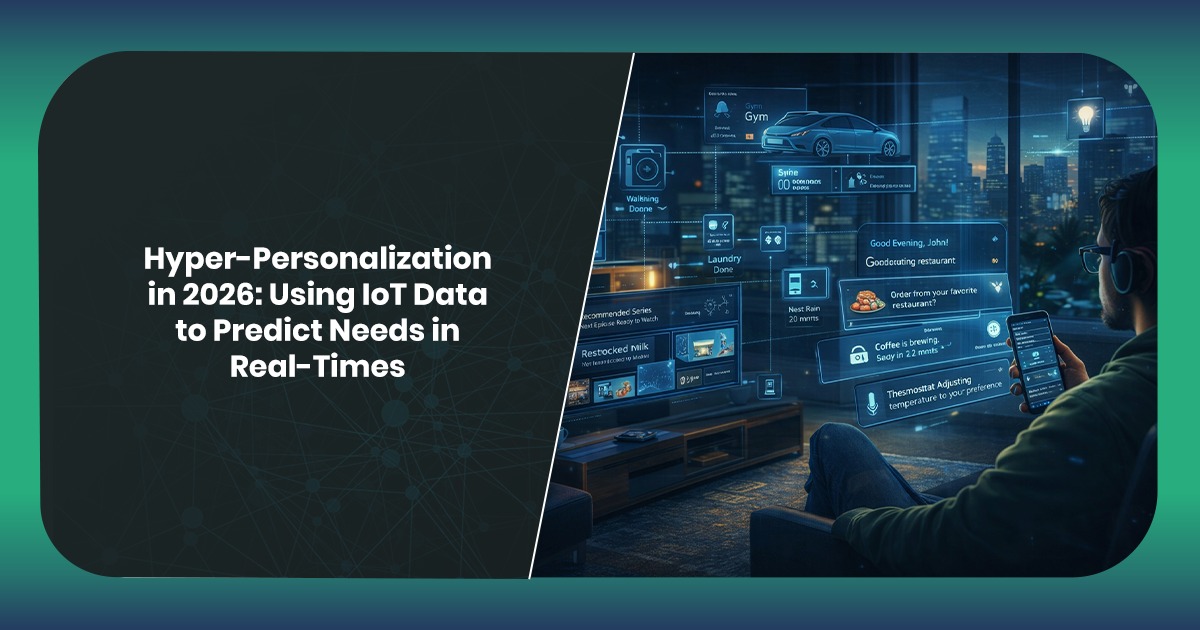
Customer experience is entering a new phase. As we enter early 2026, businesses are no longer just reacting after customers take action. Instead, they are predicting what customers may truly need. At the center of this shift lies IoT-driven hyper-personalization, where real-time data from connected devices are used to predict customer expectations.
Hyper-personalization is not a new concept. It’s been a couple of years since businesses have begun custom-tailoring emails, product/service recommendations, and interfaces. What’s new in 2026 is the ability to personalize continuously, contextually, and proactively, based on real-world behavior instead of just previous clicks alone.
In this blog post, you will learn about how IoT-driven hyper-personalization works and why it matters today. Additionally, you will discover how it is reshaping customer experience across industries so that you can also take measurable steps for consistent business growth.
Why Traditional Personalization is Not Effective Anymore
Traditional practices of personalization depend strongly on customer data including past purchases, browsing history, demographic assumptions, and static segments. While this approach improves relevance, it has a fundamental limitation: it reacts only after the customer acts.
Nowadays, potential customers have high expectations from experiences that adapt instantly to their current context, which includes:
- Where they are
- What they are doing
- How their environment is changing
- What they are likely to require next
If you’re relying solely on static data, it won’t be enough to meet their expectations. For that, you will require continuous and real-time signals. And that’s where involving IoT can make a huge difference.
What IoT-Driven Hyper-Personalization Really Means
An IoT-focused hyper-personalization approach involves using insights from connected devices that helps businesses understand customer behavior in real-time. The IoT-driven devices that can be considered are:
- Industrial sensors
- Smart vehicles
- In-store IoT-driven systems
- Connected home appliances
- Smart wearables (such as smartwatches, fitness trackers, smart clothing, and smart glasses)
With any of these IoT-driven devices, businesses can start gaining direct, precise insights into real-world usage patterns. These smart devices help them avoid depending on baseless assumptions and focus on smart, data-driven decision-making.
How IoT Enables Real-Time Customer Understanding
IoT devices generate continuous streams of data that reflect actual behavior. When this data is processed intelligently, it reveals patterns that traditional systems miss.
For example: Usage frequency indicates changing preferences and sensor data identifies anomalies. These IoT-driven solutions are designed to infer intent naturally before customers even have to reach out and convey their requirements. This shift from explicit input to behavioral signals is what enables hyper-personalization.
Use Case: Predictive Retail Experiences Using IoT Signals
In retail, IoT-driven systems such as cameras, beacons, RFID, and smart shelves, can monitor customers’ in-store movement and interact with products in real time. In case, when a returning customer re-visits a store or browses a smart retail setup, the system will effectively notice usage patterns like time spent near certain product sections or repeat interactions with particular products. WIth these critical insights, businesses can proactively recommend personalized offers, suggest complementary products, or notify the team to assist at the right moment. This smart move creates a seamless, tailored experience for customers without requiring them to search or ask.
Forecasting Customer Requirements Instead of Reacting to Them
In the competitive business landscape, the most effective customer experiences are predictive rather than reactive. Understanding customer needs before they have to convey is the core objective for businesses in the long-run. With IoT-driven hyper-personalization approaches in place, businesses can easily:
- Identify needs before customers articulate them
- Offer guidance at the right moment
- Prevent issues instead of resolving complaints
- Adapt experiences dynamically without manual input
Prediction does not mean guesswork. It is based on patterns learned from real usage, contextual signals, and continuous feedback loops. Remember, when customers truly feel that the business understands their requirements without having to explain themselves, trust and satisfaction increase naturally.
Critical Approaches Behind IoT-Driven Hyper-Personalization
1. Real-Time Context Awareness
IoT provides situational context such as locations, environments, usage conditions. Contextual awareness assists systems to discover why a customer might need something that the particular business is offering. This way you can avoid relying solely on customer historical data.
2. Continuous Data Feedback Loops
Unlike static customer feedback, IoT-driven solutions are trained to update user preferences continuously and in real-time. This way, every interaction with customers refines the personalization approach for the future recommendations.
3. Predictive Behavior Modeling
IoT devices help businesses understand customer behavior through data collected from different connected systems so they can act early, recommend better options, and deliver more personalized experiences
4. Seamless Cross-Touchpoint Experiences
IoT systems are used to connect physical and digital touchpoints. They ensure that personalization stays unwavering across various digital channels and environments.
5. Adaptive Experience Delivery
With IoT-driven systems in place, personalization can be modified as conditions change. The systems don’t rely on user input or manual configuration. This is how the customer experience gets personalized automatically with adaptive changes.
Benefits of Hyper-Personalized Experiences
If you think that the achievement lies in the total amount of data collected by your systems, then you’re probably wrong. The real achievement depends on the actual outcomes such as:
- Reduced friction and effort
- Faster resolution of issues
- Higher engagement consistency
- Improved customer satisfaction
- Stronger long-term loyalty
Hyper-personalization practice genuinely improves customer experience. They usually don’t notice the technology behind it, they simply want to be understood. This proactive approach leads to better customer needs understanding so you can fulfill their demands in real-time.
Why IoT-Driven Hyper-Personalization Will Define Customer Experience in 2026
In today’s highly competitive market, personalization is no longer a competitive advantage for businesses, it’s what your customers expect. Businesses that rely solely on historical or segmented personalization methods will struggle to keep pace with real-time, predictive experiences. IoT-driven hyper-personalization enables organizations to move at the speed of customer behavior rather than lag behind it.
All a business needs to keep in mind is that the future of customer experience belongs to systems that learn continuously, adapt instantly, predict needs responsibly, and tailor them meaningfully. IoT-driven systems can do it smoothly. That’s why such platforms are widely preferred by modern businesses to know their customers quickly, understand their needs, and deliver what they actually require.
Trust Amenity Technologies for IoT-Driven Solutions
Choosing the right partner for your requirement of IoT-driven solutions is critical as a wrong choice can lead to improper system performance, data security risk concerns, restricted scalability options, and missed opportunities for real-time insights. Achieving real-time insights can help your business drive measurable outcomes.
With Amenity Technologies, you can effortlessly connect devices, assess real-time insights, and make data-driven decisions for better customer experiences. We offer IoT-driven digital solutions that gather, process, and evaluate data in real time, allowing intelligent decisions and secured system performance. Contact us today to know more about our IoT-based and AI solutions.
FAQs
Q.1. What types of customer data are being used in IoT-driven hyper-personalization?
A: For IoT-driven personalization, contextual and behavioral data such as environmental signals, device usage patterns, interaction frequencies, and location context are preferred by systems. When this data is used effectively, relevance can be automatically improved without requiring customers to manually input information.
Q.2. Does a large IoT ecosystem require a business to begin with hyper-personalization?
A: No. Many businesses begin hyper-personalization practices with limited IoT data sources and then expand gradually. Even if you can ensure a small number of connected signals, it can provide meaningful insights when combined with smart analytics and personalization logic approaches.
Q.3. Which industry is benefitting most from IoT-based hyper-personalization?A: No single industry is the sole beneficiary; rather, IoT-based hyper-personalization is transforming manufacturing, healthcare, IT, retail, smart environment, and mobility. Any industry that communicates with customers through connected devices can benefit from IoT-based hyper-personalization.
