
 ALL ARTICLES
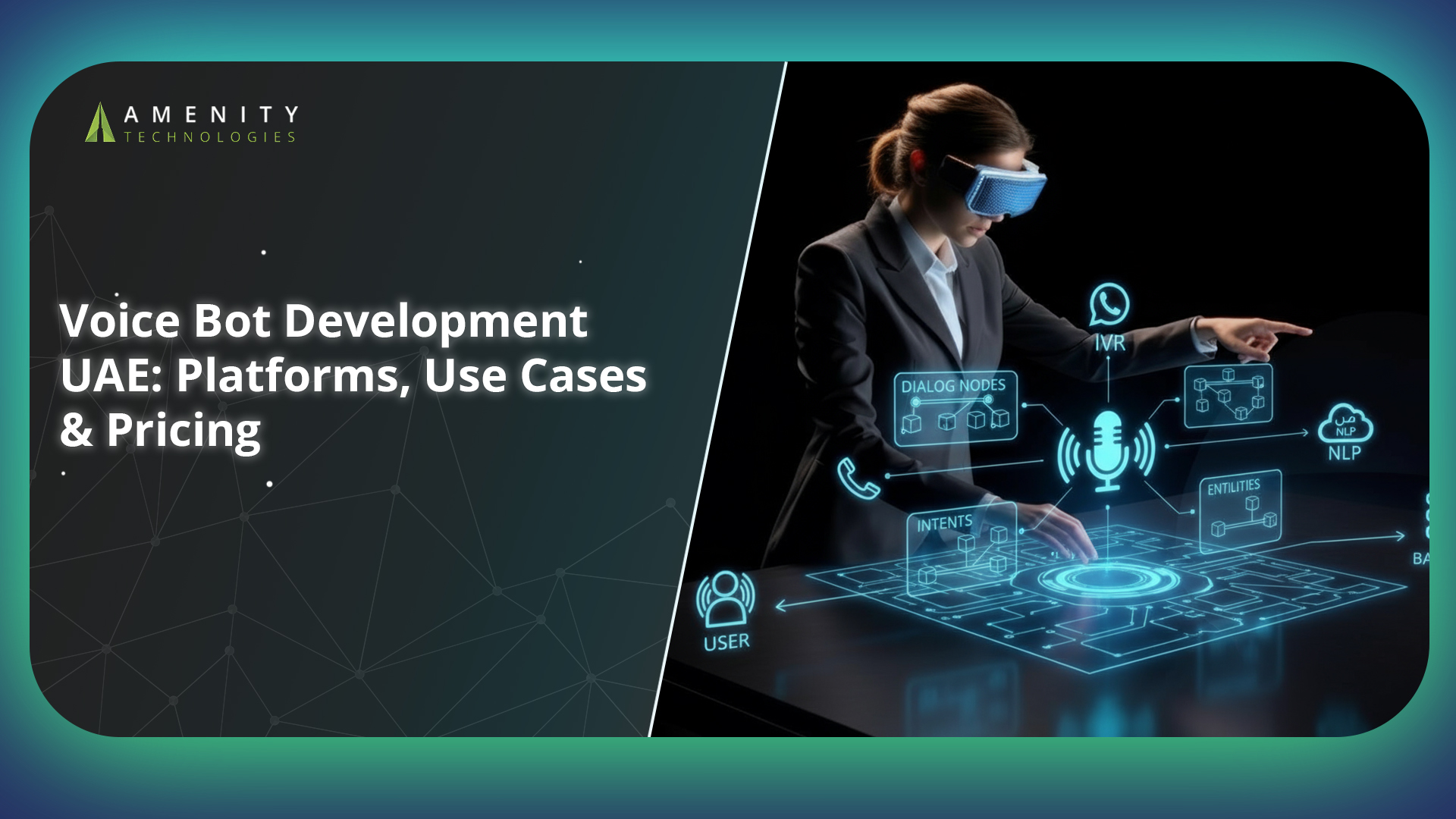



What if every customer call in the UAE could be answered instantly, in Arabic or English, without a long wait or confusion? That’s exactly what a voice bot can achieve today.
Across the region, enterprises and government services are turning to AI voice solutions that understand dialects, switch between languages, and handle real conversations with human-like flow.
But how do you build one that meets local telecom standards and business goals?
Successful voice bot development UAE projects now focus on bilingual accuracy, Arabic speech models, and seamless integration with enterprise tools. From smarter contact centers to voice-enabled commerce, the right voicebot platform is changing how businesses connect, respond, and serve users across the Emirates.
Key Platform Options for Voice Bot Development in UAE
Choosing the right voicebot platform determines how well your voice bot performs in real-world UAE conditions. Dialect accuracy, latency, and integration depth all define long-term success. Local enterprises are now evaluating both global and regional solutions to ensure that their systems work with Arabic-English interactions, telecom APIs, and enterprise workflows. Below are key areas to assess before starting any voice bot development in the UAE project.
What to Evaluate in a Voice Bot Platform?
Before selecting a voicebot platform, teams should measure performance based on metrics that matter in the UAE market.
- ASR accuracy across Arabic dialects and English: Gulf Arabic and Emirati accents need localized datasets for consistent results.
- Latency and fallback logic: Sub-second responses keep voice conversations natural. Fallback rules should handle uncertainty without user frustration.
- Integration support: Compatibility with CRM systems, telephony gateways, and backend APIs ensures smooth automation.
- Analytics and monitoring: Dashboards for intent detection, call duration, and drop-offs help refine performance.
- Voice UX tools: A design layer that enables conversation testing, confidence scoring, and flow editing improves user satisfaction.
When these parameters are benchmarked early, AI voice chat bot projects can achieve measurable uptime and conversational fluency.
Commercial and Enterprise Platforms in UAE & Global
Enterprises in the UAE often adopt commercial AI voice solutions for faster implementation and managed support. Platforms such as:
- IBM Watsonx Assistant
- Google Cloud Speech
- Microsoft Azure Speech
now include Arabic-language models and telephony connectors.
Local technology providers like G42 and Core42 add regional deployment flexibility, enabling compliance with UAE data residency laws.
These enterprise options work well when scalability, analytics, and integration are priorities. Many include plug-ins for call automation, CRM updates, and multilingual handling.
For public-sector clients, on-prem deployment options help maintain compliance with government security standards. As a result, businesses building a voice bot can rely on tested infrastructure without extensive maintenance overhead.
Open-Source and Custom Stack Options
For organizations that need full control over model training and deployment, open solutions like Whisper or Vosk can power a custom stack.
Combining these with NLU engines such as Rasa creates a flexible voice interface AI setup. This path works best when specific dialects or restricted environments require in-house hosting.
The tradeoff lies in ownership and upkeep. Custom systems allow tighter privacy control and regional tuning but demand more engineering and dataset management.
When voice bot development in the UAE include custom computer vision software development or complex analytics, this approach gives teams deeper visibility across models and performance layers.
Use Cases for Voice Bots in UAE (2025)
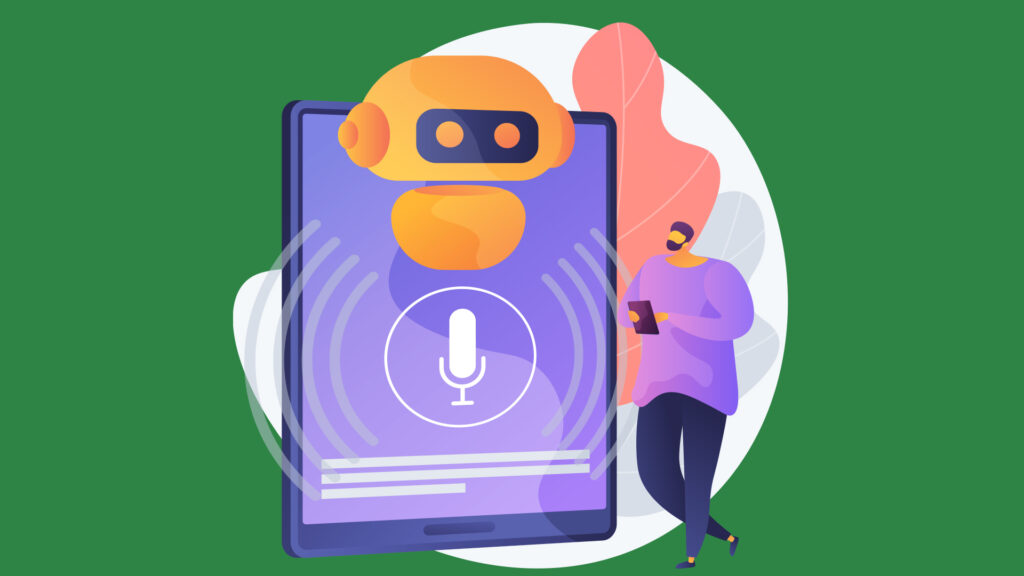
The demand for voice bot solutions across the UAE continues to grow as organizations prioritize faster customer interactions and reduced operational load.
Businesses are applying AI voice solutions to automate support, improve accuracy, and provide smoother user experiences across Arabic and English. Below are the key real-world scenarios where voice bot development in the UAE is delivering tangible impact.
1. Customer Support via Voice and Call Center Automation
Customer service teams in the UAE now rely on AI customer service bot systems to manage high call volumes. A voice bot can greet users, classify intent, and answer frequent questions before passing complex issues to human agents.
Multilingual support is a core expectation. A multilingual voice bot that detects Arabic or English automatically ensures that every caller is understood. Integration with CRM or ticketing systems allows instant case updates and call summaries.
The result is improved first-call resolution and reduced queue time without sacrificing accuracy or tone.
2. Voice IVR and Interactive Voice Response Enrichment
Traditional IVR menus are giving way to conversational voice bot flows that feel more natural. Instead of pressing numeric options, callers can simply say what they need, such as “connect me to accounts” or “check my payment.”
Call automation AI tools now retain context between interactions, so users no longer repeat information during transfers.
By linking voice logic to backend data, businesses gain more flexible routing and faster handling, improving both customer satisfaction and system efficiency.
3. Appointment Booking, Reminders, and Scheduling
Sectors like healthcare, government, and salons use voice bot systems for appointment scheduling and reminders.
A voice interface ai can confirm bookings, send reminders, or reschedule appointments through voice commands.
Integration with SMS or WhatsApp ensures confirmations reach users who prefer text follow-ups. This automation improves attendance rates while freeing staff from repetitive coordination tasks.
4. Voice Commerce and Voice Ordering
Retail and food service providers are adopting voice bot development UAE solutions for order placement.
Customers can speak their order, confirm items, and even receive product suggestions through AI voice chat bot logic.
Payment verification and order confirmation happen through secure voice prompts that reduce input friction. These voicebot platform features help boost order accuracy, shorten checkout time, and create a smoother buyer experience.
5. Internal Voice Assistants for Enterprises
Within organizations, enterprise voice bot deployments are streamlining internal communication.
Employees can use a voice UX layer to query databases, retrieve KPI dashboards, or log operational updates hands-free. Field teams benefit most, like factory and logistics workers can record inspection notes or safety reports through speech instead of manual input.
In industries combining audio and visual analysis, integrating custom computer vision software development enhances automation further, supporting tasks like quality control and inventory checks.
These implementations cut manual effort, lower data entry errors, and deliver measurable productivity gains.
Pricing Models and Cost Drivers for Voice Bot in UAE
Budgeting for a voice bot project requires understanding what influences the total investment. Costs vary widely across the UAE based on dialectal complexity, integration scope, and compliance with telecom standards. Before starting any voice bot development UAE project, it helps to know what pricing ranges to expect and which variables have the strongest impact.
Sample Cost Estimates and Ranges
Project budgets depend on system depth and business goals.
- A basic voice bot prototype that covers limited dialogue flows and English-only recognition can be developed at moderate cost, comparable to chatbot builds.
- A mid-level system supporting Arabic and English with CRM or telephony integration involves higher ASR licensing fees and additional voice UX design.
- Full-scale enterprise voice bot deployments with dialect coverage, analytics dashboards, and advanced context handling require larger budgets.
Arabic dialect processing increases cost because of dataset creation, model fine-tuning, and speaker verification testing. Local vendor rates and regulatory approval cycles also influence timelines and pricing structures.
What Drives Cost in UAE Projects?
Several technical and operational components directly affect voice bot pricing:
- ASR licensing: Speech recognition for Arabic dialects often includes per-minute usage fees.
- Dialect coverage: Models trained on Gulf Arabic and Emirati accents require additional data labeling.
- Integration complexity: Tying the AI voice chat bot into CRM, telephony, or ERP systems adds configuration time.
- Voice UX and error handling: Fine-tuned conversation design improves satisfaction but adds design cost.
- Monitoring and model retraining: Continuous updates ensure accuracy as dialect data evolves.
- Latency tuning and scaling: Achieving fast response times needs optimized infrastructure.
When custom computer vision software development is combined with voice automation, for instance, in retail or logistics, the integration of visual and audio models adds a new cost layer but provides better automation outcomes.
Pricing Models in the Market

Most AI voice solutions providers in the UAE offer flexible billing structures.
- Subscription models charge per session or per minute, often tiered by usage volume.
- Usage-based pricing allows pay-as-you-go flexibility for startups or pilot projects.
- Custom enterprise agreements include a base fee plus overage charges tied to call volume or integration complexity.
- Hybrid models combine a fixed platform subscription with variable usage costs, suitable for companies scaling across multiple departments.
Billing in AED helps local clients manage currency exposure. For cross-border setups, vendors may quote in USD with localized service-level agreements.
Transparent pricing helps project owners match operational demand with real expenditure, ensuring the voicebot platform remains sustainable long term.
How Amenity Technology Helps Build Voice Bots for UAE Clients?
Delivering a high-performing voice bot in the UAE starts with structured planning and regional insight. Amenity follows a transparent build process that ensures quality and compliance at every stage.
1. Discovery and Architecture Setup
The process begins with analyzing client workflows, language requirements, and telecom needs. Amenity’s engineers assess which voicebot platform or hybrid stack suits the use case—whether enterprise-grade or open-source. This step includes defining ASR and NLU components, voice flow logic, and integrations with CRM or backend APIs.
2. Language and Dialect Optimization
Arabic-English switching is common across the UAE, so Amenity fine-tunes the Arabic voice bot models using regional speech data. Gulf Arabic and Emirati accents receive focused testing. Accuracy targets are set early, and fallback logic ensures a smooth experience for all callers.
3. Voice UX and Dialogue Design
A strong voice UX design shapes the entire interaction. Dialogues are scripted, tested with local users, and refined for tone and clarity. Confidence thresholds are adjusted to minimize misunderstandings.
4. Integration and Testing
Amenity connects the voice bot to telephony, APIs, and internal data systems. Testing occurs under real call conditions to validate latency and speech performance. Telephony compliance is verified to meet UAE regulations.
5. Deployment and Optimization
Once stable, the system moves to production with active monitoring. Amenity tracks response speed, error frequency, and call outcomes, applying regular updates. When paired with custom computer vision software development, multimodal applications can also identify users or verify physical processes for advanced enterprise setups.
Through this structured approach, Amenity ensures every voice bot development UAE project runs efficiently, scales reliably, and delivers consistent results in both Arabic and English environments.
How Amenity Technologies Can Help with Voice Bot Development in UAE?
At Amenity Technologies, we specialize in building intelligent voice solutions for businesses across the UAE. Our teams combine expertise in AI, NLP, and multilingual systems to deliver voice bots that understand diverse user accents, regional dialects, and real business workflows.
- Strategic Expertise and Proven Experience:
We bring deep technical knowledge in voice bot development, covering speech recognition, natural language understanding, and conversational design. Our prior experience with regional and cross-language chatbot systems helps UAE enterprises serve both Arabic and English users with natural, context-aware interactions.
- Structured Voice Bot Architecture for UAE Clients
We design and implement every voice bot using a modular approach. Our teams select the right ASR and NLU stack suited for bilingual environments, plan dialogue flows with effective error handling, and build systems that retain context through memory management. Integration covers telephony, APIs, and backend platforms, ensuring that every voice bot functions as part of a connected digital ecosystem.
- Testing and Optimization for Local Performance
We perform extensive QA, latency tuning, and live voice testing across UAE dialects to ensure accurate recognition and fast response times. Each deployment undergoes validation for quality, accessibility, and compliance with regional communication norms.
- Comprehensive Delivery and Engagement Flexibility
We manage full lifecycle execution—from concept and prototype to production deployment and ongoing support. Our teams operate under defined SLAs, provide transparent pricing, and deliver regular model updates. Clients can engage us for full project delivery, staff augmentation, or targeted advisory support based on their internal capabilities and timelines.
Conclusion
A well-built voice bot is now a key business tool in the UAE, not a future concept. Companies use AI voice solutions to shorten response time, improve service consistency, and connect better with Arabic- and English-speaking users.
Success depends on accurate dialect handling, compliant telephony integration, and ongoing optimization. Teams that approach voice bot development UAE projects with strong architecture and data discipline achieve better ROI and customer trust.
With Amenity Technologies, organizations get proven delivery methods and measurable results from every voicebot platform implementation across Gulf markets.
FAQs
Q1: Can a voice bot understand Emirati Arabic dialects?
Yes. A voice bot can support Emirati Arabic through model fine-tuning and dialect-specific training data. Local testing ensures clear recognition and accurate intent matching across Gulf accents.
Q2: Is it legal to operate a voice-based system in the UAE?
Yes, provided it follows local telecom regulations. Projects under voice bot development UAE must connect through licensed VoIP or telecom providers approved by the TDRA.
Q3: How long does it take to build a voice bot in the UAE?
A simple AI voice chat bot can be completed within 8 – 12 weeks. Larger deployments with integrations and dialect training usually need 4 – 6 months for full production rollout.
Q4: What is the average cost of developing a voice bot?
Basic voice bot prototypes are cost-effective, while enterprise-grade systems with bilingual support, analytics, and telephony integration require higher investment. Dataset creation for dialects adds to total cost.
Q5: Which platforms work best for Arabic and English voice bots?
Platforms offering bilingual ASR and NLU, such as Watsonx Assistant or regionally tuned open-source models, deliver reliable results for ai voice solutions and enterprise voice bot needs.
Q6: How can a voice bot stay accurate after launch?
Accuracy improves through active monitoring, feedback analysis, and retraining. Businesses retrain models on new voice samples, adjust confidence levels, and refine flows based on live data.